


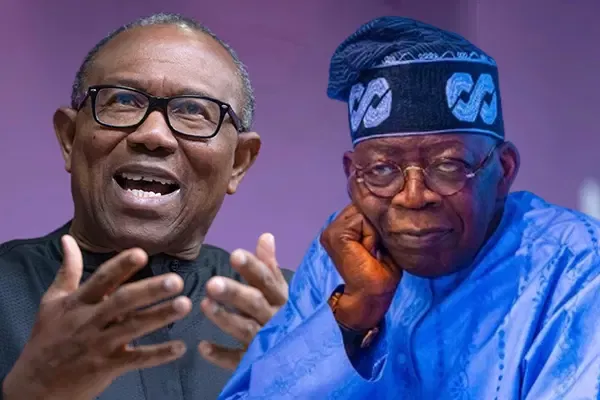
Tinubu’s reckless borrowing spree faces criticism as Peter Obi warns Nigeria’s debt may hit N200 trillion with little to show for growing loan
Labour Party’s 2023 presidential candidate, Peter Obi, has raised alarm over what he called Tinubu’s reckless borrowing spree, warning that Nigeria’s total debt may cross N200 trillion by the end of 2025.
Also read: Peter Obi Criticises Tinubu Over Misleading Economic Claims
He criticised the administration’s approval of massive external loans without transparency or productive results, describing it as dangerous for the country’s future.
Obi reacted to the Senate’s recent approval of an external borrowing plan that includes $21 billion, €2.2 billion, and ¥15 billion for the 2025–2026 fiscal cycle.

Alongside a N750.98 billion domestic bond issuance and a €65 million grant, the latest round of debt pushes Nigeria’s total public borrowing to around N187 trillion.
He made his remarks via a post on X, formerly Twitter, on July 29.
According to the former Anambra governor, “With an already existing public debt of about N149.39 trillion as at the first quarter of 2025, adding the approved loans brings our current total debt to about N187 trillion with concerns that our debt might likely be over N200 trillion by the end of 2025.”
Obi decried the rising debt-to-GDP ratio, which, based on pre-rebasing figures, is already nearly 70%.
Even with rebased GDP now estimated at N372.8 trillion (approximately $243.7 billion), he warned that the debt load remains unsustainable.
He argued that the government’s borrowing binge has not translated into any noticeable improvements in critical sectors such as education, healthcare, infrastructure, or job creation.
“We are accumulating very exponential levels of unsustainable debt with little or nothing to show for it,” Obi said.
“Education is underfunded, healthcare remains inaccessible, and our roads and power infrastructure are in a state of decay.”
He also raised concerns about worsening insecurity, citing government data showing over 10,000 deaths and hundreds of sacked villages between May 2023 and May 2025, despite a surge in security budgets from N2.98 trillion to N4.91 trillion over the same period.
Obi added that the country’s road infrastructure remains largely unmotorable, with 135,000 kilometres of roads still unpaved.
Borrowing without accountability, without transparency, and without transformational impact is simply mortgaging the future of our children.
Meanwhile, power generation continues to underperform, with supply hovering below 5,000 megawatts for over 200 million Nigerians.
He further lamented the deepening poverty crisis.
“Today, over two years after the present government took over, we are still confronted with negative reports of worsening poverty, with about 133 million Nigerians classified as multi-dimensionally poor,” Obi said.
Highlighting recent figures from Médecins Sans Frontières, which reported 652 child deaths due to malnutrition in Northern Nigeria, Obi said it was disgraceful for a resource-rich country like Nigeria to leave millions hungry.
“Borrowing is not inherently bad if it is sustainable and tied to productive investments with measurable outcomes,” Obi explained.
“Unfortunately, this current pattern of borrowing without accountability, without transparency, and without transformational impact is simply mortgaging the future of our children.”
He urged the federal government to shift course by embracing fiscal discipline, reducing the cost of governance, closing revenue leakages, and prioritising human capital development.
“The government should consider the inter-generational consequences of their unsustainable borrowings and show at least a minimum consideration and interest in future of young and unborn Nigerians,” he warned.
In conclusion, Obi called for a “New Nigeria,” where responsible leadership delivers measurable development results.
Also read: Peter Obi Urges Compassion, Criticises Tinubu’s Leadership Style
“We must build a New Nigeria, where leadership is responsible, development is people-centred, and every kobo borrowed or spent delivers a measurable impact,” he said.


