


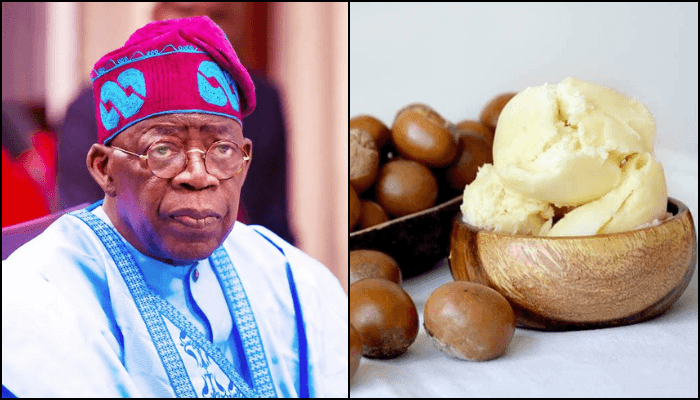
President Tinubu’s 6-month ban on raw shea exports aims to boost the Nigerian shea industry, enhance processing, and unlock $300M in short-term earnings
Nigerian shea industry is set for a major transformation as President Bola Ahmed Tinubu approved a six-month temporary ban on the export of raw shea nuts.
Also read: Tinubu’s Global Outreach to Energize Nigeria’s Diplomatic, Economic Horizons
The directive, aimed at curbing informal trade and unlocking domestic value, is expected to catalyze growth in Nigeria’s underutilized shea sector.
The announcement was made by Vice President Kashim Shettima during a multi-stakeholder meeting at the Presidential Villa in Abuja on Tuesday.

“This is not an anti-trade policy. It is a pro-value addition policy,” Shettima said.
“It’s designed to protect raw materials for our processing factories, boost rural incomes, and create jobs.”
Nigeria produces nearly 40% of the world’s shea yet accounts for just 1% of the global $6.5 billion market.
The new directive is projected to unlock $300 million in short-term earnings, with the goal of increasing that tenfold by 2027.
“Government is not closing doors; we are opening better ones,” Shettima emphasized, noting that Nigeria has already secured future access to the Brazilian market for shea butter and oil.
Minister of Agriculture and Food Security, Senator Abubakar Kyari, revealed that while Nigeria produces an estimated 350,000 metric tonnes of shea annually, most local processors are operating at only 35–50% capacity, even though national installed capacity is 160,000 metric tonnes.
Kyari noted that over 90,000 metric tonnes are lost annually to informal cross-border trade, making Nigeria the most vulnerable in the region.
He praised the ban as a step toward industrialization and domestic value addition.
Highlighting the gender and social impact, Shettima stressed that women form the backbone of the shea value chain.
“By protecting the Nigerian shea industry, we protect the dignity and livelihoods of millions of women,” he said.
“This is a move that promotes industrialization, gender empowerment, and rural transformation.”
Countries like Ghana, Mali, Burkina Faso, and Togo have already implemented export restrictions to safeguard local value chains.
Nigeria’s new policy brings it into strategic alignment with regional players and positions it for dominance in the expected $9 billion global shea market by 2030.
“With over five million hectares of wild-growing shea trees, Nigeria holds both comparative and absolute advantage,” Kyari added.
The ban is temporary and subject to review after six months, but its goals are long-term: securing domestic supply, expanding processing capacity, and shifting Nigeria from an exporter of raw kernels to a global supplier of refined derivatives like shea butter, olein, and stearin.
Also read: Tinubu Moves Surveyor-General’s Office to Presidency
“Today, we plant the seeds of an industry that will yield fruit for decades,” Shettima concluded.


