


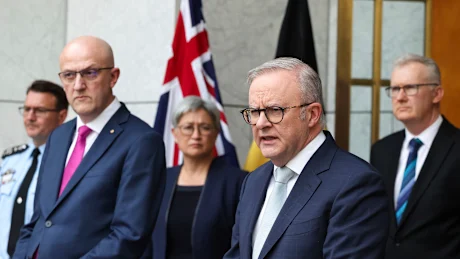
Australia expels Iranian ambassador over antisemitic arson attacks in Sydney and Melbourne, marking its first diplomatic expulsion since World War II
Australia expels Iranian ambassador Ahmad Sadeghi in a dramatic diplomatic move following damning intelligence that linked Iran to antisemitic arson attacks in Sydney and Melbourne.
Also read: Iran Denies Meddling in Gaza Ceasefire Talks After Trump’s Claim
The expulsion marks the first time Australia has taken such action since World War II — a powerful message to the international community about foreign interference on Australian soil.
Prime Minister Anthony Albanese announced that Iran was responsible for orchestrating the October 2024 arson at a kosher café in Sydney’s Bondi suburb and the December 2024 blaze at the Adass Israel Synagogue in Melbourne.

No injuries were reported in either incident, but the damage sent shockwaves through Jewish communities nationwide.
“These were extraordinary and dangerous acts of aggression orchestrated by a foreign nation,” Albanese said.
“They were attempts to undermine social cohesion and sow discord in our community.”
Australian intelligence services, after what they described as a “painstaking” investigation, determined that Iran’s Islamic Revolutionary Guard Corps (IRGC) directed the attacks using a network of proxies.
Michael Burgess, director-general of the Australian Security Intelligence Organisation, said the operation was deliberately hidden behind layers of covert influence.
However, he noted that Iran’s diplomats in Australia were not directly involved.
The IRGC has long been accused internationally of operating shadow campaigns abroad.
In response, Australia plans to formally designate the IRGC as a terrorist organisation.
Iranian Ambassador Ahmad Sadeghi and three other officials have been declared persona non grata and given seven days to leave the country.
Simultaneously, Australia has withdrawn its own ambassador from Tehran and suspended operations at its embassy — a post open since 1968.
Foreign Minister Penny Wong stressed that while diplomatic lines remain open, consular assistance to Australians in Iran is now “extremely limited.”
“I urge any Australian who might be considering travelling to Iran, please do not do so,” she warned. “If you are an Australian in Iran, leave now if it is safe to do so.”
For Australia’s Jewish community, the revelation offers some measure of clarity — though it also deepens concerns.
“There will be great anxiety that we have been targeted in such a callous and calculated way, by a ruthless and violent foreign force, because of who we are,” said Daniel Aghion, president of the Executive Council of Australian Jewry.
The Adass Israel Synagogue fire, described as one of the most severe antisemitic attacks in recent memory, occurred in the context of global unrest following Hamas’ October 7, 2023, attack on Israel and the subsequent war in Gaza.
The Embassy of Israel in Australia welcomed the decision to expel the Iranian diplomats and label the IRGC a terrorist organisation, calling it “a step we have long advocated for.”
Meanwhile, Iran’s embassy in Canberra has not yet issued an official response.
Counterterrorism expert Levi West of Australian National University said the expulsion is a strong political signal, even though bilateral ties between Australia and Iran are relatively limited.
“We don’t have any defence arrangements or major intelligence sharing with Iran,” he noted.
“This was an important move — both symbolic and strategic.”
Also read: Israel vs Iran: What Is Nigeria’s Foreign Policy Thrust?
With this action, Australia joins a growing list of Western countries tightening pressure on Iran for its transnational activities — a move likely to draw global attention in the evolving landscape of foreign interference.


