


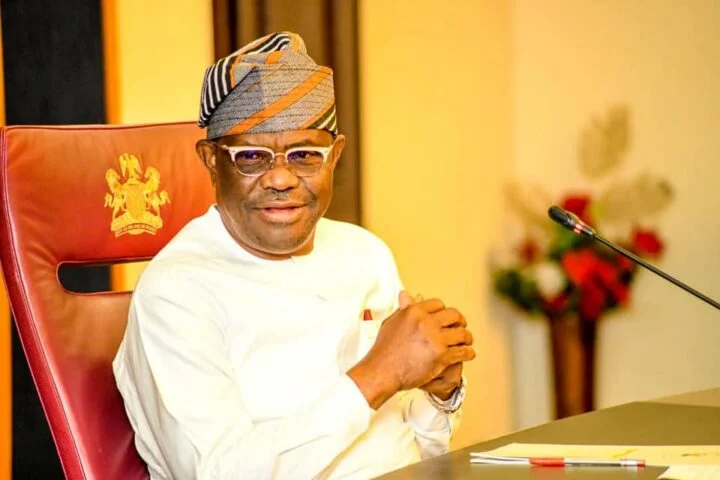
Wike says Atiku could face a major challenge in the South if Tinubu loses ground in the North ahead of Nigeria’s 2027 presidential election
Minister of the Federal Capital Territory Nyesom Wike has said former Vice President Atiku Abubakar could face serious difficulties in southern Nigeria if President Bola Ahmed Tinubu loses ground in the North ahead of the 2027 presidential election.
Also read: Wike Backs Chinda as Next Rivers Governor
Wike made the assessment during a media chat in Port Harcourt, Rivers State, on Wednesday, September 2, 2026, while discussing the political realignments and regional calculations emerging ahead of the next presidential contest.
The FCT minister said the political strategy adopted by the G5 governors during the 2023 election was designed in part to limit Atiku’s support in the South.
“If Tinubu has problem in the North, Atiku will have in the South,” Wike said.

Wike, who was one of the five governors that formed the G5 bloc within the Peoples Democratic Party, PDP, before the 2023 election, said the group understood that Atiku represented the principal challenge to Tinubu’s presidential bid at the time.
He argued that the decision by the PDP to retain a northern presidential candidate despite demands for power rotation influenced the position taken by the G5 governors.
According to Wike, the group sought to redirect support in parts of the South towards Labour Party candidate Peter Obi as part of its effort to weaken Atiku’s electoral position.
“We knew the man contesting against Tinubu in 2023 was Atiku. We wanted then Benue State governor to support Obi. We also told Cross River to support Obi and Oyo to support him. This was done to defeat Atiku,” he said.
The remarks provide further insight into the political calculations behind the G5’s decision to distance itself from the PDP’s presidential campaign in 2023.
The group, comprising Wike and former governors Samuel Ortom of Benue, Seyi Makinde of Oyo, Okezie Ikpeazu of Abia and Ifeanyi Ugwuanyi of Enugu, had demanded that the PDP’s presidential candidate should come from the South after eight years of northern leadership under President Muhammadu Buhari.
The disagreement contributed to deep divisions within the PDP’s campaign structure and became one of the defining political disputes of the 2023 election.
Wike also questioned the extent of Peter Obi’s electoral popularity, despite the former Anambra State governor’s strong following among sections of Nigerian voters.
He argued that public enthusiasm around Obi should not automatically be interpreted as evidence of nationwide electoral strength.
“To Obi, he is very popular each time people shout Obi-Obi. After the NBA Conference, where they shouted his name, I’m sure he went home satisfied. But in the real sense, he is not popular,” Wike said.
The comment comes as Obi continues to feature prominently in discussions about the 2027 opposition landscape.
Political parties and prominent politicians have increasingly been exploring alliances and realignments as they prepare for the next general election, with the possibility of a broad opposition coalition remaining a major subject of debate.
Wike’s latest comments also highlight the importance of regional voting patterns in Nigeria’s presidential elections.
Although presidential candidates require broad national support, the distribution of votes across Nigeria’s geopolitical zones can have a decisive impact on the final outcome.
The 2027 contest is therefore expected to involve intense efforts by the major political camps to consolidate support in their traditional strongholds while making gains in regions where their opponents have historically performed strongly.
For Atiku, who has contested the presidency several times, maintaining and expanding his support in the South will be an important part of any campaign strategy.
For Tinubu, securing sufficient backing in the North will similarly remain crucial to any bid for a second term.
Wike’s argument suggests that neither candidate can afford to take regional support for granted.
His comments also underline the extent to which the political alliances that shaped the 2023 election could continue to influence the 2027 contest, even as politicians move between parties and form new partnerships.
With the election still months away, the political landscape remains fluid, and the strength of the various alliances will ultimately depend on candidates, campaign structures and voters’ choices across the country.
Wike’s assessment is therefore best understood as a political reading of the emerging contest rather than a prediction of the eventual result.
Also read: Wike Backs Chinda as Next Rivers Governor
The 2027 election will determine whether the regional calculations that shaped the previous presidential contest remain relevant or whether new alliances will produce a markedly different electoral map.


