


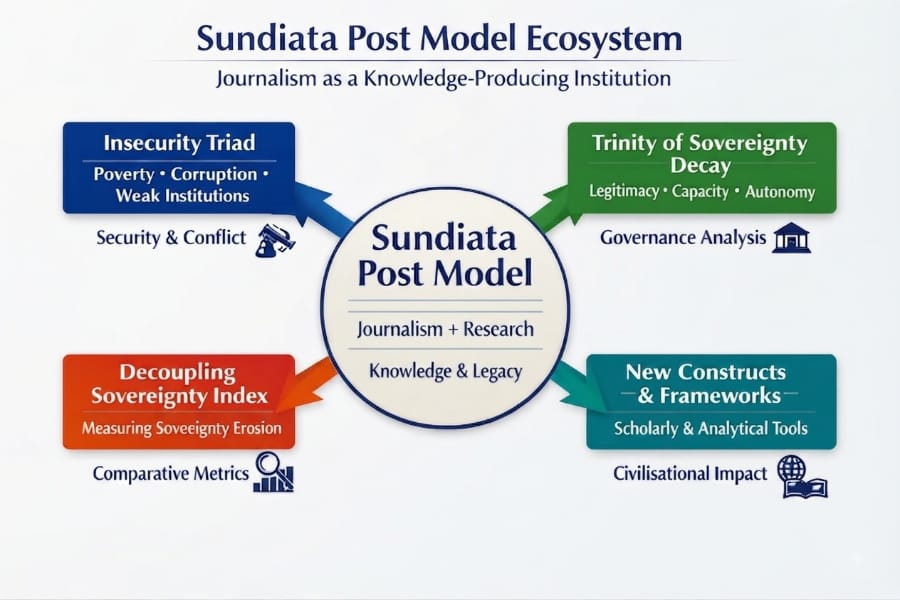
The seven-part framework proposes a knowledge-producing newsroom built around journalism, research, institutional memory and long-term stewardship
Language does more than describe reality. It shapes how we perceive it.
Also read: The Sundiata Post Model (4): Realm of the long term
Every enduring discipline eventually develops its own vocabulary. Law has its language. Medicine has its language.
Economics, engineering, diplomacy and computer science all possess conceptual vocabularies that enable practitioners to describe phenomena with greater precision than ordinary language permits.

Journalism is no exception.
Yet the vocabulary of journalism has largely remained rooted in the 20th century.
We continue to speak of newsrooms, reporters, editors, publishers, news cycles and audiences—concepts that remain important but no longer fully capture the realities of a profession transformed by digital technology, artificial intelligence, data science and knowledge production.
If journalism itself is changing, then its language must also evolve.
Throughout this series, I have argued that the 21st century newsroom should no longer be understood merely as a producer of news but as a knowledge-producing institution.
That institutional transformation inevitably requires a corresponding conceptual transformation. New realities require new language.
A Note on the Definition of the Sundiata Post Model
In Part 1 of this series, I defined the Sundiata Post Model as an institutional framework for media-based knowledge production.
The development of the Model across the subsequent parts has, however, clarified its institutional character and conceptual architecture. I therefore refine that original definition here and assert the following as the canonical definition:
The Sundiata Post Model is an institutional model for media-based knowledge production in which an independent newsroom systematically integrates journalism, original research, conceptual innovation, and scholarly dissemination to produce original analytical constructs that contribute to public understanding, academic inquiry, and policy discourse within the global knowledge ecosystem.
Its conceptual framework sets out the principles, structures, processes and mechanisms through which such a newsroom can become a knowledge-producing institution and sustain that capacity over time.
The Sundiata Post Model (SPM) therefore proposes not simply an institutional model but also a vocabulary through which its conceptual framework can be understood and communicated.
This vocabulary should not be viewed as rigid terminology imposed upon the profession. Language evolves through use rather than decree.
Some concepts will prove useful. Others may be revised or replaced. Ultimately, the value of any terminology lies not in its novelty but in its capacity to illuminate reality more clearly.
What follows is therefore an emerging lexicon for 21st century journalism. It gives language to the ideas developed throughout this series.
Knowledge-Producing Institution
Perhaps the central concept within the SPM is the Knowledge-Producing Institution.
Traditional media organisations produce journalism.
A knowledge-producing institution produces journalism while simultaneously generating research, analytical frameworks, datasets, policy knowledge and institutional memory.
It informs today’s public while contributing to tomorrow’s understanding.
This distinction represents the philosophical foundation upon which the entire model rests.
Dual Engine Architecture
The Dual Engine Architecture describes the internal structure through which journalism and knowledge production become mutually reinforcing.
The Media Operations Engine generates journalism, public engagement and commercial activity.
The Knowledge Operations Engine converts that journalistic activity into research, intellectual frameworks, datasets, publications and institutional knowledge.
Together they create a continuous cycle in which journalism enriches research and research strengthens journalism.
Media Operations Engine
The Media Operations Engine is the institution’s public-facing operational system.
It encompasses reporting, editing, verification, multimedia production, audience engagement, commercial publishing, conferences, public events and other activities through which the institution serves society while generating the resources necessary to sustain its mission.
Knowledge Operations Engine
The Knowledge Operations Engine is the institution’s intellectual infrastructure.
It conducts research, develops theories, constructs analytical frameworks, curates datasets, preserves institutional memory and maintains standards for methodology, research quality and knowledge governance. It transforms information into enduring knowledge.
Institutional Intelligence Cycle
The Institutional Intelligence Cycle describes the continuous movement of knowledge between journalism and research.
Reporting generates observations.
Observations generate questions.
Research transforms those questions into structured knowledge.
That knowledge subsequently enriches journalism, producing deeper reporting and more informed public discourse.
The cycle then begins again.
Knowledge therefore accumulates rather than disappears.
Institutional Memory
Institutions do not become enduring simply because they survive. They become enduring because they remember.
Institutional Memory refers to the organised preservation of knowledge generated through journalism, research, governance and public engagement.
It ensures that experience accumulates across generations rather than disappearing with personnel changes, the passing of news cycles or successive algorithmic transformations.
Knowledge Stewardship
Creating knowledge is only the beginning.
Knowledge Stewardship concerns the responsibility to preserve, organise, govern and transmit that knowledge responsibly across generations.
It treats intellectual assets not as temporary outputs but as permanent institutional resources.
Knowledge Governance
If knowledge is to become an institutional asset, it must also be governed.
Knowledge Governance refers to the principles, systems and standards through which institutions ensure methodological integrity, research quality, documentation, accessibility, preservation and responsible use of knowledge.
It provides order to institutional intelligence.
Realm of the Long Term
Every institution eventually reaches the point where immediate performance gives way to long-term stewardship.
The Realm of the Long Term describes that stage in institutional development.
Here, management shifts its attention from short-term success to enduring relevance.
Leadership becomes stewardship.
Growth becomes continuity.
Performance becomes permanence of purpose.
The Seven Pillars
The Seven Pillars constitute the institutional foundations upon which the Realm of the Long Term rests:
Financial Sustainability
Human Capital and Leadership
Knowledge Stewardship
Governance
Innovation and Adaptation
Trust and Reputation
Mission Continuity
Together they provide a practical philosophy for institutional endurance.
The Logic of the Long Term
The Logic of the Long Term is the principle that enduring institutions are sustained not by isolated organisational strengths but by the interaction of mutually reinforcing capabilities.
Within the SPM, it explains why the Seven Pillars operate as an integrated institutional system rather than as independent functions.
Institutional Success
Within the SPM, institutional success extends beyond commercial performance. It encompasses four progressively deeper levels.
Operational Success measures present performance.
Institutional Success measures organisational endurance.
Civilisational Success measures the institution’s enduring contribution to society’s accumulated stock of knowledge.
Legacy measures Generational Influence—the extent to which an institution’s ideas, values, methods and contributions continue shaping future generations.
Success is therefore measured not only by what institutions produce, but ultimately by what continues because the institution existed.
The Triple Institutional Architecture
The SPM is not only an institutional model. Its development has also generated an emerging institutional architecture through which its principles can be expressed in practice.
That architecture consists of three complementary institutions: Sundiata Post Media Ltd., the Sundiata Post Intelligence Unit (SPIU), and the Sundiata Post Foundation.
Sundiata Post Media Ltd. constitutes the media and public-information institution. Its primary function is journalism: reporting, investigation, verification, public engagement and the dissemination of knowledge to society. The Sundiata Post Intelligence Unit (SPIU) constitutes the research and knowledge institution.
Its function extends beyond journalism into original research, conceptual innovation, analytical constructs, datasets, policy research and scholarly dissemination.
The development of The Insecurity Triad, the Trinity of Sovereignty Decay (TSD) and the Decoupling Sovereignty Index (DSI) demonstrates the potential for this research function to generate original intellectual contributions rather than merely reproduce existing knowledge.
The Sundiata Post Foundation constitutes the social-impact and civic-engagement institution within the wider ecosystem.
Together, these institutions form a Triple Institutional Architecture:
Media—Knowledge—Social Impact
The three institutions are distinct in function but complementary in purpose.
Their differentiated institutional roles create distinct but mutually reinforcing pathways for sustaining public value.
This architecture also extends the Dual Engine Architecture of the SPM beyond the internal structure of a newsroom.
The Media Operations Engine and Knowledge Operations Engine remain the core internal mechanisms of the knowledge-producing institution, while the Triple Institutional Architecture shows how those functions can connect to a wider institutional ecosystem in which journalism, research and social impact reinforce one another.
The four original constructs developed through the Sundiata Post intellectual project provide an initial proof of concept for the knowledge-producing capacity underlying this architecture.
The Triad demonstrates the capacity to develop an original analytical lens. The TSD demonstrates theoretical innovation.
The DSI represents an attempt to translate theory into an empirical measurement system. The SPM itself provides the institutional model through which such knowledge can be generated, preserved and disseminated.
The significance, therefore, lies not in the existence of four ideas or three institutions independently, but in their interaction.
The constructs demonstrate intellectual production.
The institutions provide organisational embodiment.
The architecture connects knowledge production to public value.
Beyond Journalism: Strategic Management and Organisational Theory
The SPM sits at the intersection of journalism and media studies, organisational theory, and strategic management.
From journalism and media studies, it draws on the tradition of public service—a profession dedicated to informing society, strengthening democracy, and contributing to public understanding.
From organisational theory, it draws on the study of how institutions are designed, governed, sustained and renewed over time, emphasising organisational structure, institutional memory, culture, stewardship and long-term continuity.
From strategic management, it draws on the principles of institutional endurance—financial sustainability, governance, human capital development, innovation, knowledge stewardship and mission continuity.
These are not separate concerns.
The SPM argues that journalism cannot fulfil its public purpose without institutional strength, and that institutional strength cannot be built without understanding journalism’s unique mission.
This interdisciplinary foundation is reflected throughout the Model—in its Dual Engine Architecture, its Seven Pillars, its measures of institutional success, and its proposed vocabulary.
Each element integrates the concerns of both fields, offering a framework that is both mission-driven and institutionally grounded.
A Living Vocabulary
No vocabulary is ever complete.
The language proposed in this series should therefore be understood as a living intellectual framework rather than a finished dictionary.
As journalism evolves, new concepts will emerge. Existing concepts will be refined. Some terms may disappear altogether while others become widely adopted. That is how intellectual traditions develop.
History reminds us that new ways of understanding the world often begin when someone gives language to a previously unnamed reality.
Once that language gained acceptance, the underlying ideas became easier to understand, debate and improve.
The SPM aspires to make a similar contribution. Its value will not be determined by whether every term survives unchanged, but by whether this vocabulary helps journalists, scholars, media executives and researchers think more clearly about what the newsroom of the 21st century can become.
If that conversation continues beyond these pages—if these concepts are questioned, tested, adapted and applied—then the language will have served its purpose.
Because institutions are built with systems.
Ideas are built with language.
The future of journalism will require both.
Across these seven parts, I have defined the problem, formulated a new institutional model, proposed its architecture, articulated its guiding principles, developed measures of success, and finally given it its own vocabulary.
Together, these elements give the SPM its internal coherence and completeness.
A Philosophical Triad of Enduring Influences
With humility, drawing on decades of experience at the forefront of the African media industry, a fellowship at the highest level of the Chartered Institute of Human Resource Management (CIHRM), foundational membership in the Institute of Strategic Management Nigeria, and from my desk at Sundiata Post in Abuja, I release these ideas—the Sundiata Post Model—into the world. Their future is no longer mine to determine.
If they endure, it will not be because I insisted upon their importance, but because others found them worth questioning, testing, adapting and building upon.
For many years, my life journey and the arc of my interdisciplinary thinking have been shaped by a philosophical triad of enduring influences.
The first is Sigmund Freud’s insight that “immortality means being known by many anonymous people”—which, to me, revealed the possibility that ideas can outlive their creators and that the truest measure of intellectual work lies not in personal recognition but in the enduring life of ideas.
The second is Edward Said’s vision of the intellectual as one who engages society’s most pressing questions with independence, integrity, and moral courage.
The third is Antonio Gramsci’s conception of the organic intellectual, which helped me see journalism as far more than the reporting of events.
It reframed journalism for me as an intellectual vocation—one that interprets reality, organises knowledge, frames public understanding, and contributes to society’s accumulated stock of learning.
Together, these three influences have shaped my conception of journalism not merely as a profession, but as an intellectual vocation and a means of creating knowledge that can outlive its creator.
If, through the development of four original constructs—The Insecurity Triad, the Trinity of Sovereignty Decay, the Decoupling Sovereignty Index, and now the Sundiata Post Model—I have made a meaningful contribution in that tradition, I am content to leave the judgment to history and to those who engage with these ideas in the years ahead.
Also read: Nigerian Scholar Max Amuchie Joins ScienceOpen as Expert Reviewer
This series is concluded.
Trust is sacred. Stay seasoned.


