


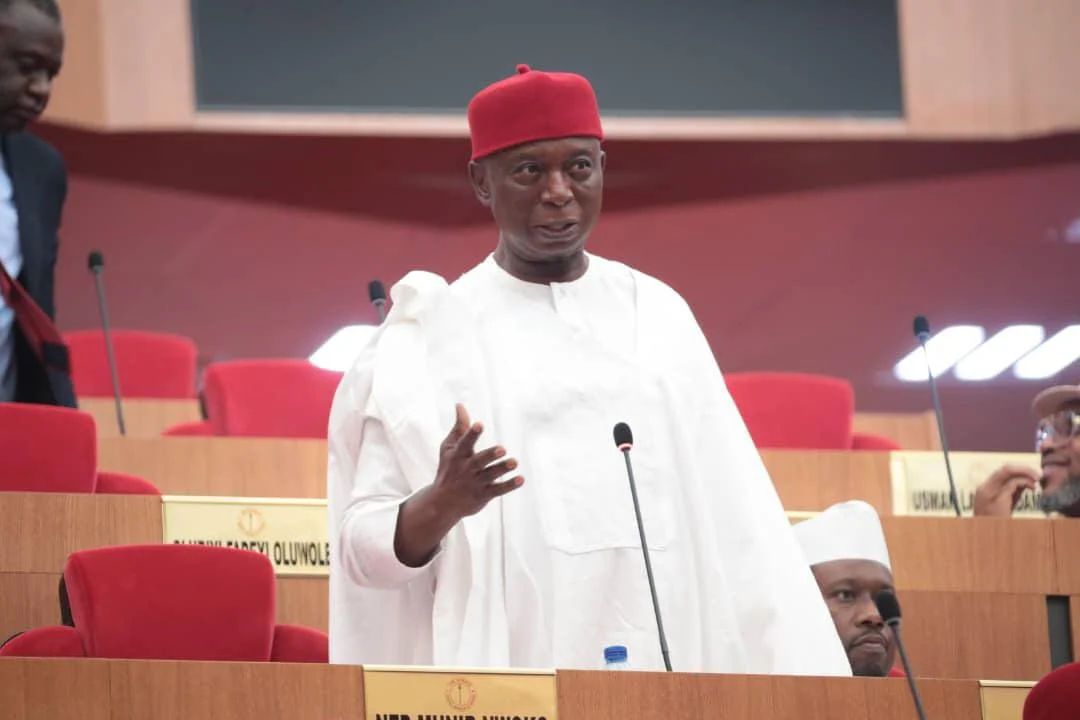
Ned Nwoko defends constitution, saying Nigeria’s 1999 charter is functional and should be amended rather than replaced entirely amid reform calls
Ned Nwoko defends constitution of the Federal Republic of Nigeria, asserting that the 1999 charter remains a functional and guiding document despite mounting calls for its replacement.
Also read: Anioma State Creation Support Not Political Game, But Call For Unity, Says Ned Nwoko
The Delta North Senator made the remarks during a live interview on Channels Television’s Sunrise Daily on Friday.
“Personally, I do not subscribe to the idea that we should throw away the current constitution and create an entirely new one. It’s a workable document, and it has been guiding what we are doing in Nigeria so far,” he said.

Nwoko’s comments come amid growing agitation from civil society organisations, regional interest groups, and political actors who argue that the current constitutional framework is outdated and ill-suited to address the structural imbalances and governance deficiencies plaguing Nigeria.
However, the lawmaker maintained a contrary stance, contending that no constitution in the world is flawless and that Nigeria’s own can be perfected through a deliberate and strategic amendment process.
“There cannot be any perfect constitution anywhere in the world. All you can do is propose amendments and hope that those amendments go through so that whatever the wishes of the people are can be reflected,” Nwoko stated.
He acknowledged public frustration over perceived injustices and lapses in the system but urged fellow lawmakers and advocates to consider the risks and complexities of discarding the 1999 document entirely.
While the constitution, inherited from Nigeria’s return to democracy in 1999, has faced heavy criticism for entrenching federal dominance and stifling state autonomy, Nwoko argued that the charter still offers a legal framework capable of accommodating reforms.
The Senator’s comments align with a segment of the National Assembly that prefers piecemeal adjustments to key areas such as state policing, resource control, and electoral reforms, rather than launching a wholesale constitutional rewriting process.
His position also reflects growing divisions within Nigeria’s political elite on how best to approach constitutional change.
It’s a workable document, and it has been guiding what we are doing in Nigeria so far.
While some southern governors, prominent legal scholars, and ethnic leaders have championed a complete redraft to produce a “People’s Constitution,” Nwoko insisted that legislative diligence and constitutional mechanisms must be respected.
His intervention is particularly notable as the Senate continues deliberations on various amendment bills introduced during the current legislative session.
Areas under consideration include devolving more powers to states, reforming the judiciary, and adjusting the federal character principle.
Nwoko’s opposition to an entirely new document, however, may frustrate those advocating for radical change, especially in light of Nigeria’s security crisis, economic disparities, and widespread disenchantment with the political structure.
Yet, he maintains that discarding the 1999 Constitution would create legal uncertainty and institutional instability.
He said that responsible governance demands that the country build on its existing legal foundation rather than dismantle it.
As Nigeria grapples with competing visions for national unity, resource distribution, and democratic governance, the debate over constitutional reform is unlikely to abate soon.
Nwoko’s voice adds a cautionary note to the clamour for sweeping constitutional transformation.
His argument reinforces the view that the solution lies not in the abandonment of the legal framework, but in the political will to make it responsive to the aspirations of Nigerians through the proper channels of amendment.
Also read: Obasanjo’s constitutional operators concern overshadows amendment calls
Whether this moderate position will gain traction within the broader national conversation remains to be seen, but the Senator from Delta North has made it clear: reform, not revolution, is his preferred path forward.


