


Wike Fubara reconciliation gains momentum as Rivers leaders meet in Port Harcourt to strengthen political unity ahead of the 2027 elections
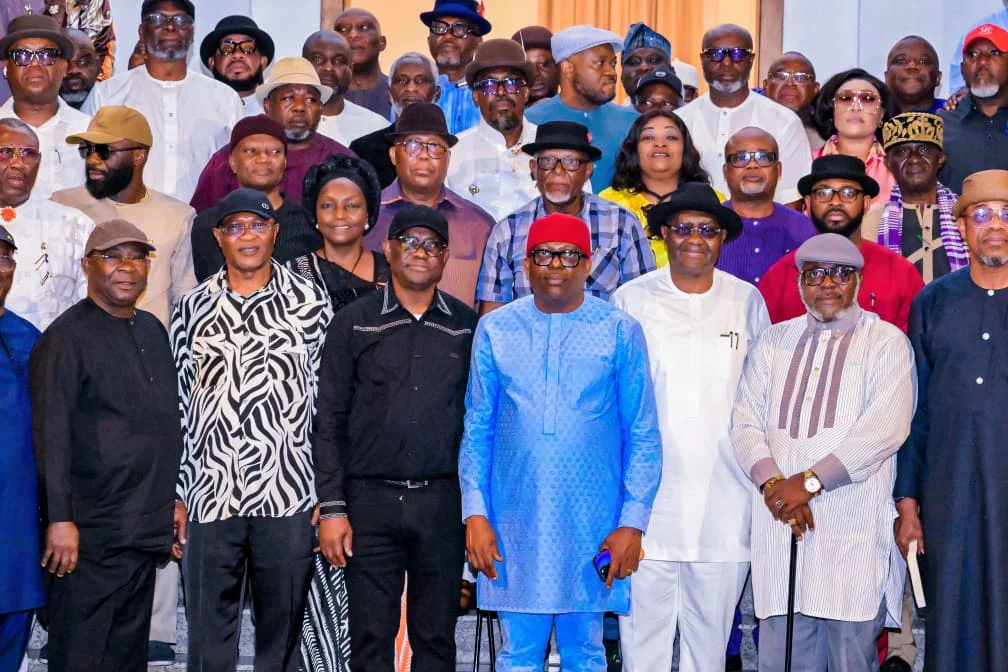
Nyesom Wike, Minister of the Federal Capital Territory, Siminalayi Fubara, Governor of Rivers State, Kingsley Chinda, the All Progressives Congress governorship candidate in Rivers State, and former Senator Magnus Abe met at Fubara’s private residence in Port Harcourt on Tuesday, October 6, 2026, in a fresh effort to consolidate the political reconciliation that has followed years of bitter rivalry in the state.
Also read: Alli Campaign Says Bala Mohammed’s Tinubu Praise Undermines Makinde’s 2027 Bid
The closed-door meeting, which lasted several hours, brought together senior figures and supporters from the different camps that had been divided by the prolonged political dispute between Wike and Fubara.
It was also the first known visit by Wike to Fubara’s private residence since the crisis between the two politicians escalated and subsequently gave way to a reconciliation process.
Although the participants did not publicly disclose the details of their discussions, the gathering is being viewed against the backdrop of continuing efforts to reunite the political network around the Rainbow Coalition before the 2027 general elections.

The meeting also included Abe, who has chaired a reconciliation committee established within the Rainbow Coalition, as well as Chinda and other political supporters.
The committee had previously held meetings with Fubara at Government House as part of attempts to determine how members of the governor’s political camp could be accommodated within the emerging arrangement.
The latest Wike Fubara reconciliation meeting comes after months of increasingly public signs that the political relationship between the two men has changed dramatically.
In July, Fubara publicly declared his support for the Rainbow Coalition, a political movement associated with Wike, and endorsed Chinda as his preferred candidate for governor in the 2027 election. Fubara also declared support for President Bola Ahmed Tinubu.
“I am already in the family. I have returned to our family,” Fubara said at the time, urging his supporters to support the coalition.
Fubara also described the change in the political atmosphere in Rivers in simple terms: “The time of war is over; it is now time for peace.”
That declaration represented a striking turn in a relationship that had once threatened the stability of the Rivers political establishment.
Wike, who governed Rivers from 2015 to 2023, had played a major role in Fubara’s emergence as his successor.
Their relationship subsequently deteriorated into a prolonged struggle over political influence and control of the state’s political structures.
The dispute eventually spread to the Rivers State House of Assembly and became one of the most consequential political crises in the country.
The crisis reached a critical stage in March 2025 when President Tinubu suspended Fubara, his deputy and members of the Rivers State House of Assembly after months of political confrontation.
The intervention was followed by negotiations involving Wike, Fubara and the lawmakers.
By June 2025, Wike announced that the principal actors had agreed to work together after a meeting with Tinubu at the Presidential Villa in Abuja.
“We have all agreed to work together with the governor, and the governor has also agreed to work with all of us,” Wike said after the meeting, describing the politicians as members of the same political family.
Fubara subsequently said that peace had returned to Rivers State, although the political relationship between the different camps continued to require further reconciliation.
That process became more structured in 2026. The Rainbow Coalition’s reconciliation committee, headed by Abe, held successive meetings with Fubara and other stakeholders. In August, the committee said that members would not be victimised or discriminated against because of their positions during the earlier dispute.
Abe said the discussions had made “very good progress”, while other coalition figures described the emerging reconciliation as an attempt to restore the political family that had existed before the dispute.
Wike also subsequently acknowledged Fubara’s role in the reconciliation. In September, the FCT minister said the governor had demonstrated sincerity in efforts to rebuild relations with members of the political group.
The October meeting therefore appears to be another stage in that process, rather than an isolated encounter.
Its political significance is heightened by the approach of the 2027 elections. The Rainbow Coalition is seeking to consolidate support across political camps in Rivers, with Chinda emerging as its governorship candidate and Fubara publicly urging his supporters to align with the coalition.
The alliance has brought together politicians with different party backgrounds, making reconciliation a particularly important part of its strategy. The political calculations are also broader than the Rivers governorship, with Fubara having declared support for Tinubu’s bid for another term as president.
Still, Tuesday’s meeting should not automatically be interpreted as evidence that every disagreement within Rivers politics has disappeared. The reconciliation process has involved negotiations over how different political interests will be accommodated, and the details of the latest discussions have not been made public.
What is clear is that the relationship between Wike and Fubara has moved considerably from the confrontation that once dominated Rivers politics.
The sight of Wike meeting Fubara privately, alongside Chinda, Abe and supporters from different political camps, provides another visible indication of that shift.
For Rivers State, the immediate question is whether the emerging political truce can develop beyond meetings between senior politicians and translate into a durable arrangement that is accepted by their respective supporters.
With the 2027 election approaching, the coming months are likely to test whether the reconciliation can hold under the pressure of candidate selection, campaign structures and competing political interests.
Also read: Alli Campaign Says Bala Mohammed’s Tinubu Praise Undermines Makinde’s 2027 Bid
For now, the Port Harcourt meeting has added a fresh and potentially significant chapter to a political story that has already moved from confrontation to negotiation, and now towards an increasingly organised attempt at reconciliation.


