


Senate tenancy laws could strengthen tenant identity checks, regulate short-let apartments and help Nigeria combat human trafficking and kidnapping
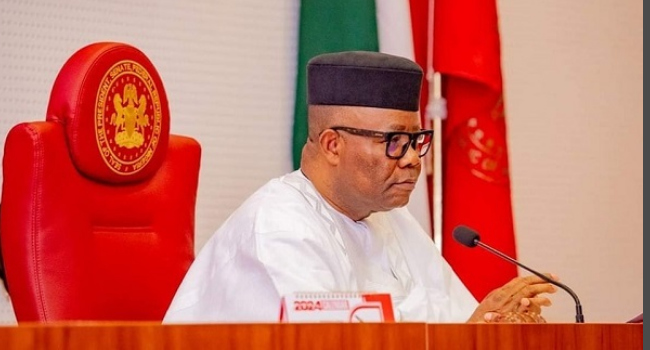
Nigeria’s Senate, led by Senate President Senator Godswill Akpabio, has called for stricter tenancy laws requiring landlords to verify tenants’ identities, including through the National Identification Number (NIN), in Abuja on 27 October 2026, as part of a broader effort to combat human trafficking, kidnapping and related criminal activities.
Also read:Wike Hails Adamawa Governor Fintiri on 59th Birthday
The proposed measures would also strengthen the regulation of short-let apartments, investigate travel agencies suspected of facilitating the exploitation of Nigerians abroad and improve support for trafficking survivors returning home.
The resolutions followed consideration of a report on protecting Nigerians from trafficking, slavery and human rights abuses in Libya.

The report was presented by the Senate Committees on Diaspora and Non-Governmental Organisations, Judiciary, Human Rights and Legal Matters, Foreign Affairs, and Special Duties.
Senator Akpabio argued that inadequate tenant identification could leave room for criminal activity, with properties rented to unidentified individuals potentially providing cover for unlawful operations.
He called for existing laws to be reviewed so that tenants could be properly identified and traced when necessary.
The proposal places landlords and property managers within a wider national conversation about public safety, accountability and the responsibilities associated with renting out residential accommodation.
However, the effectiveness of any new requirements would depend on clear legal provisions, practical enforcement and safeguards for legitimate tenants.
Former Sokoto State Governor and Senator Aminu Tambuwal supported stronger regulation, drawing on his previous legislative experience as a Speaker of a State House of Assembly.
Tambuwal advocated measures covering tenant registration, rent control and security checks, while also calling for landlords to establish proof of ownership of their properties.
He urged the National Assembly to encourage state legislatures to adopt similar provisions, recognising that tenancy regulation and property administration require coordination across different levels of government.
Senator Babangida Hussaini, who represents Jigawa North-West, pointed to Lagos State’s existing tenancy legislation as a possible reference point for lawmakers considering further reforms.
Lagos enacted its Tenancy Law in 2011 to regulate the rights and obligations of landlords and tenants, although the Senate’s proposed identity-verification measures would require their own clear legal basis and implementation framework.
Senator Adams Oshiomhole broadened the discussion beyond domestic property arrangements, highlighting the organised and cross-border nature of human trafficking.
His contribution underscored the importance of tackling international criminal networks and the foreign collaborators who may facilitate the exploitation of Nigerian victims.
Alongside the proposed tenancy reforms, the Senate called on the National Agency for the Prohibition of Trafficking in Persons (NAPTIP) to work with the Nigeria Police Force, Nigeria Immigration Service, Economic and Financial Crimes Commission (EFCC), Ministry of Foreign Affairs and other relevant agencies to investigate travel agencies allegedly connected to trafficking and exploitation abroad.
The proposed investigations are expected to examine recruitment networks, financial transactions and travel arrangements associated with suspected offences.
The allegations remain subject to investigation, and any individuals or businesses implicated would be entitled to due process.
The focus on travel agencies reflects a wider challenge facing Nigeria, where trafficking can involve deceptive recruitment, promises of employment abroad and organised networks operating across international borders.
A January 2026 country report by the European Union Agency for Asylum documents both domestic and cross-border trafficking involving Nigerian victims, including exploitation in sex trafficking and forced labour.
The report also describes the role of organised criminal groups in recruitment and exploitation, reinforcing the need for investigations that extend beyond individual perpetrators to the networks, intermediaries and financial arrangements that sustain such crimes.
The Senate’s proposals would also strengthen the review and enforcement of existing anti-trafficking legislation, including the Trafficking in Persons (Prohibition), Enforcement and Administration Act, as amended in 2015, and the Child Rights Act of 2003.
Nigeria’s existing legal framework already criminalises human trafficking and provides for the investigation and prosecution of offenders.
The challenge, however, extends beyond the existence of legislation to the resources, coordination and institutional capacity required to implement it consistently.
The United States Department of State’s 2024 Trafficking in Persons Report recorded 698 trafficking investigations initiated by Nigerian authorities during the reporting period, alongside 48 prosecutions of alleged traffickers and 24 convictions for sex trafficking.
The report also identified continuing concerns about official complicity, corruption and gaps in victim identification and protection.
The figures illustrate the scale and complexity of the enforcement challenge, although they cover a specific reporting period and should not be interpreted as a complete measure of trafficking in Nigeria.
Against this background, the Senate called for increased funding for NAPTIP and other relevant agencies to strengthen investigations, prosecutions and victim support.
Adequate resources would be essential if the proposed measures are to translate into sustained enforcement rather than additional obligations without the capacity to deliver them.
The chamber also urged the Federal Government to establish a National Reintegration and Protection Programme for returning victims and other vulnerable Nigerians.
The proposed programme would be coordinated by the National Commission for Refugees, Migrants and Internally Displaced Persons, working with NAPTIP.
Such a programme could help address the difficulties survivors face after returning to Nigeria, including the need for safe accommodation, psychological support, legal assistance and opportunities to rebuild their livelihoods.
Reintegration is particularly important where poverty, limited employment prospects and social stigma may leave survivors vulnerable to further exploitation.
The proposals nevertheless raise practical questions about how tenant information would be collected, stored and accessed, how compliance would be monitored and how the rights of landlords and tenants would be protected.
Any new requirements would need to be proportionate, securely administered and supported by clear procedures to prevent misuse of personal information or unnecessary barriers to renting accommodation.
There is also a distinction between improving property records and preventing trafficking. Identity checks may help investigators establish who occupied a property, but they cannot, on their own, dismantle recruitment networks, prevent fraudulent overseas employment offers or guarantee that trafficking victims will be identified and protected.
The Senate’s intervention therefore signals a broader approach to tackling human trafficking, combining proposed property-sector safeguards with stronger investigations, international cooperation, law enforcement funding and survivor support.
The next test will be whether the resolutions lead to concrete legislative proposals, coordinated implementation and measurable improvements in the identification and protection of victims.
Also read:Wike Hails Adamawa Governor Fintiri on 59th Birthday
For Nigerians vulnerable to exploitation at home or abroad, the lasting value of the initiative will depend not simply on tighter rules, but on whether those rules help prevent abuse, hold perpetrators accountable and give survivors a realistic opportunity to rebuild their lives.


