


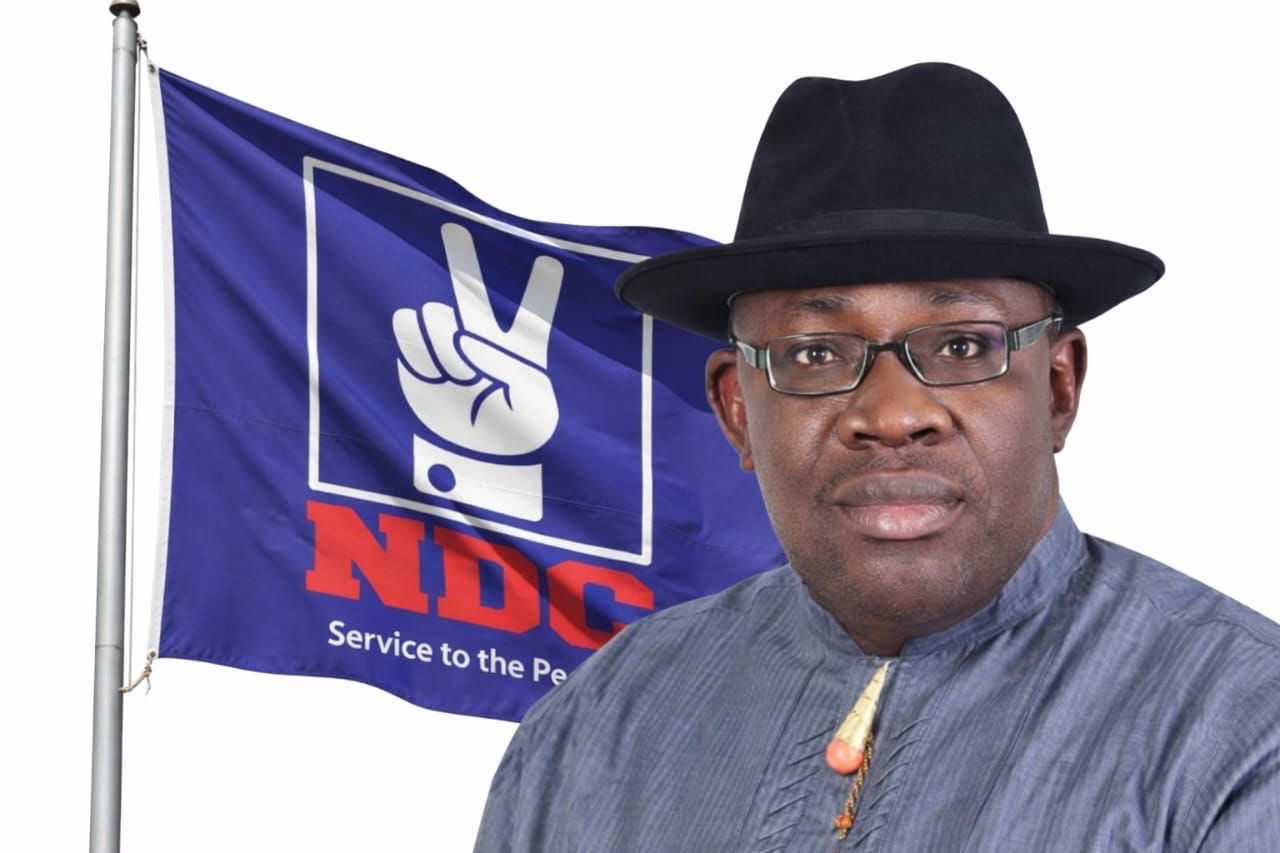
Dickson NDC merger rejection comes as the party backs opposition cooperation but insists it will contest the 2027 presidential election as NDC
Seriake Dickson, national leader of the Nigeria Democratic Congress, NDC, said in an interview on Wednesday, September 9, 2026, that the party will contest Nigeria’s 2027 presidential election under its own platform rather than merge into the emerging G-100 opposition coalition.
Also read: Seriake Dickson Clarifies NDC Loyalty Ahead of 2027
Dickson made the position clear during an appearance on Arise Television’s Prime Time, where he discussed the growing efforts by opposition figures to unite behind a single presidential candidate for the next general election.
The former Bayelsa State governor said the NDC remained willing to work with other political parties and candidates, but insisted that the party was preparing to contest the election as the NDC.
“We are going to the election as NDC. If other parties and candidates support us, as we think they should, well and good, but we are working to win the election,” Dickson said.

The statement places the NDC’s strategy within the increasingly complex effort to build a united opposition ahead of 2027.
Several opposition figures and political groups have been exploring ways to prevent votes from being divided among multiple candidates, with the G-100 coalition among the groups advocating greater cooperation.
Dickson said the NDC was aware of the coalition’s activities and broadly supported its objective of bringing opposition forces together.
“Our friends who are organising the G-100 came to see me. They are great Nigerians doing a great job, and their thinking is not misplaced,” he said.
“The NDC, in principle, endorses what they are doing, and we have made it clear that the general commitments are good and our position is very clear.”
Dickson’s position is therefore one of cooperation without absorption. The NDC is prepared to engage with other opposition parties, but the party does not intend to dissolve its identity into a wider coalition.
The distinction could become increasingly important as political negotiations intensify before the 2027 election.
Dickson argued that the NDC already has what he described as an attractive and broadly representative presidential ticket capable of appealing to Nigerians at home and abroad.
“We have the most exciting ticket. We have the most vibrant ticket. We have an appealing ticket. We have a balanced ticket. We have a ticket that resonates with the Nigerian people at home and abroad,” he said.
The NDC’s leadership is consequently presenting its existing structure as a potential centre of gravity for opposition cooperation rather than simply another participant in a larger alliance.
Dickson also called for opposition parties to eventually present a single presidential candidate in the 2027 contest, an objective that could require difficult negotiations among political groups with competing ambitions.
The call reflects a longstanding challenge for Nigeria’s opposition.
Multiple candidates can divide support, while a single candidate requires parties and political movements to surrender individual ambitions and agree on a common platform.
Dickson suggested that collaboration could take different forms without requiring the NDC to abandon its own political identity.
He pointed to recent contact between the NDC and other political groups as evidence of the party’s willingness to engage beyond its formal structure.
“Two days ago, our presidential candidate was at a campaign rally of the Allied Peoples Movement, APM, and when he finished, he came to me, and we discussed very briefly,” Dickson said.
The interaction illustrates the fluid nature of opposition politics ahead of 2027, with parties and political figures increasingly exploring possible areas of cooperation.
For the NDC, however, the central message remains firm.
The party wants to build partnerships where possible, but intends to enter the election under its own name and compete for victory.
Dickson’s comments also indicate that the emerging opposition alliance will not necessarily result in a single political organisation.
Instead, cooperation could involve parties retaining their identities while coordinating around broader electoral objectives.
The challenge will be translating that cooperation into a credible electoral strategy.
A unified opposition presidential candidate could offer a stronger challenge to the governing party, but reaching agreement over who should carry the ticket is likely to be one of the most sensitive issues facing the various groups.
With the 2027 election approaching, the NDC is positioning itself as both a participant in the opposition’s wider coalition-building efforts and a distinct political force with its own presidential ambitions.
Also read: Seriake Dickson Clarifies NDC Loyalty Ahead of 2027
Dickson’s message is that collaboration remains welcome, but the NDC’s identity and electoral strategy will remain intact.


