


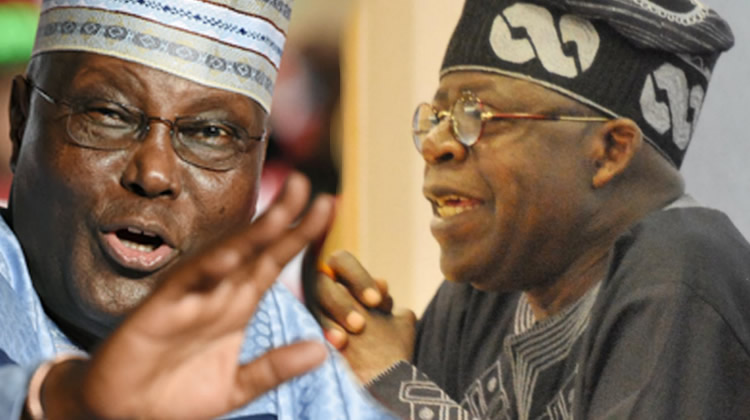
Tinubu attacks Atiku’s fuel subsidy promise, saying ₦15.8tn in post-subsidy resources has strengthened Nigeria’s federal and state finances
President Bola Ahmed Tinubu on Thursday, August 20, 2026, in Abuja, criticised former Vice President Atiku Abubakar, the African Democratic Congress presidential candidate for the 2027 election, over Atiku’s promise to restore petrol subsidies if elected, describing the proposal as evidence of “serious ignorance on governance and economy”.
Also read: Tinubu’s Fuel Subsidy Removal Faces Fresh Criticism
The exchange has opened a fresh political argument over one of the most consequential economic decisions of Tinubu’s presidency, with the administration defending the removal of the subsidy as a necessary fiscal reform while Atiku presents its restoration as part of his alternative economic programme.
Tinubu made the remarks while receiving Osun State Governor Ademola Adeleke at the Presidential Villa.
Although the president did not name Atiku directly, his reference was unmistakable, coming a day after Atiku said he would return the petrol subsidy if Nigerians elected him president in 2027.

“Okay, let’s look at the trajectory of history. I saw one of my opponents now say he will go back to subsidy. I read it. That is a demonstration of serious ignorance on governance and economy,” Tinubu said.
The president’s intervention reflects the increasingly political nature of the subsidy debate as Nigeria moves towards the 2027 presidential election.
Tinubu made the original announcement on May 29, 2023, during his inauguration, declaring that “subsidy is gone”. The decision immediately changed the economics of petrol, triggering a sharp increase in pump prices and contributing to higher transport, production and living costs.
The government has consistently argued that the subsidy had become fiscally unsustainable and that removing it would release resources for development and strengthen the finances of the three tiers of government.
Fresh figures released this week have given the administration a more detailed basis for that argument.
Finance and Coordinating Minister of the Economy Taiwo Oyedele said the removal of the petrol subsidy mobilised ₦15.8 trillion for the Federation between June 2023 and December 2025.
Of that amount, ₦5.4 trillion accrued to the Federal Government, while ₦10.4 trillion was distributed to states and local governments through the Federation Account.
Oyedele stressed that the ₦15.8 trillion should not be understood as a single payment labelled “subsidy savings”. Rather, it represents resources that became available to the Federation after the subsidy was removed.
The distinction is important because the fiscal impact of the reform has become central to the political argument over whether Nigerians have received sufficient value from the difficult policy.
The Federal Government also reported ₦3.1 trillion in additional independent revenue between June 2023 and December 2025.
Together with ₦11.9 trillion in additional borrowing, the government said the extra resources available during the period amounted to ₦20.4 trillion.
The government, however, spent considerably more than the subsidy-related resources alone.
Oyedele said incremental expenditure reached ₦30.64 trillion during the period.
About ₦9.39 trillion went towards wage adjustments, minimum wage increases and allowances for public servants, while ₦9.37 trillion was used for external debt servicing and ₦6.5 trillion for strategic infrastructure.
Those figures provide some context for Atiku’s criticism of the government’s continued borrowing.
They also complicate the argument that ending the subsidy would automatically eliminate the need for additional borrowing.
The administration’s position is that the borrowing would have been substantially higher without the fiscal space created by the reforms.
Oyedele has argued that continuing the old subsidy regime, alongside multiple exchange rates and unchecked Ways and Means financing, could have produced a deeper economic crisis.
He has nevertheless acknowledged that the reforms came with substantial costs for households and businesses, including higher prices and pressure created by the naira’s sharp adjustment.
Tinubu’s argument on Thursday focused particularly on the states.
The president said 27 states had been unable to pay salaries and pensions when he assumed office in 2023, forcing them to depend on federal bailouts.
He argued that improved federation revenues following subsidy removal had changed the fiscal position of subnational governments.
“Before I came here, 27 states were unable to pay salaries, not to even talk of pensioners, salaries of workers,” Tinubu said.
He recalled that one of Adeleke’s predecessors in Osun State had been nicknamed “Half Salary” because the state could not consistently pay workers their full salaries.
Tinubu said the additional resources available to states had enabled governments to pay salaries more regularly and invest in infrastructure, including roads, housing, schools and healthcare.
The claim about improved state finances is supported in part by recent comments from Oyedele.
The finance minister said on August 17 that no state was currently struggling to meet its salary obligations, compared with a period when as many as 27 states had faced difficulties.
But the fiscal gains have also prompted demands for greater accountability.
The Nigeria Employers’ Consultative Association has called on state and local governments to explain how the ₦10.4 trillion distributed to them from the resources associated with subsidy removal was spent.
NECA Director-General Adewale-Smatt Oyerinde said the disclosure should give state governments an opportunity to publish their own financial scorecards, allowing citizens to see how additional revenues had been deployed.
The call highlights an important part of the wider debate. Establishing that more resources became available does not, by itself, demonstrate that every naira was efficiently spent or that households have experienced a corresponding improvement in living standards.
International assessments have similarly painted a mixed picture.
The International Monetary Fund has supported Nigeria’s efforts to remove costly fuel subsidies and reform the foreign exchange system, while warning that the reforms have imposed significant short-term costs and that protecting vulnerable households remains essential.
Its 2025 assessment identified the need to ensure that fiscal savings from subsidy reform are properly channelled through the budget.
Reuters has also reported that the reforms have strengthened Nigeria’s public finances, foreign reserves and investor confidence, while contributing to a severe cost-of-living crisis for many Nigerians.
That tension now sits at the heart of the political dispute between Tinubu and Atiku.
For the Tinubu administration, restoring the subsidy would risk returning Nigeria to a system it considers financially unsustainable and vulnerable to waste.
For Atiku, the proposal represents an attempt to address the economic hardship that has followed the removal and offer relief to Nigerians facing high transport and living costs.
The debate is therefore unlikely to be settled by the size of the subsidy bill alone.
It also concerns who should bear the cost of reform, how quickly the benefits should reach households, and whether increased public revenues are translating into visible improvements in everyday life.
With the 2027 election approaching, Tinubu’s defence of the subsidy removal and Atiku’s promise to reverse it are likely to become increasingly prominent elements of the economic campaign.
For now, the government’s ₦15.8 trillion figure gives Tinubu a powerful fiscal argument for maintaining the policy.
Atiku’s counterargument rests on the lived experience of Nigerians who continue to contend with the consequences of higher fuel and living costs.
The political contest over petrol subsidies has consequently moved beyond whether the policy should exist.
Also read: Tinubu’s Fuel Subsidy Removal Faces Fresh Criticism
The sharper question for voters may be whether the resources freed by its removal have produced enough tangible benefits to justify the pain of the transition.


