


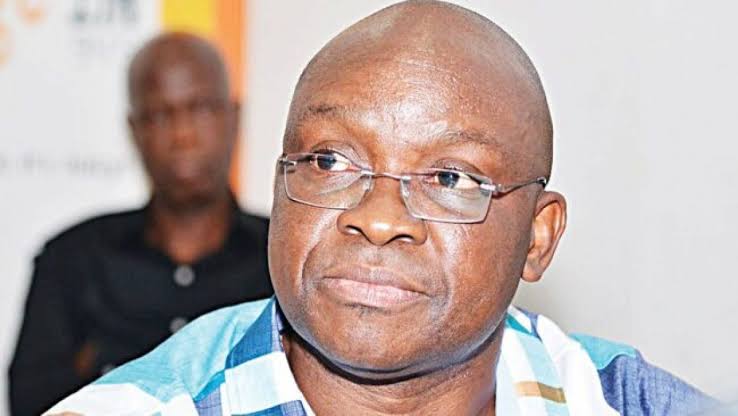
Obi 2027 chances have been weakened by opposition divisions, Ayodele Fayose says, arguing that leaving ADC for NDC reduced the opposition’s strength
Former Ekiti State Governor Ayodele Fayose has said Peter Obi’s 2027 chances were weakened when the former Anambra governor left the African Democratic Congress for the Nigeria Democratic Congress, arguing that the opposition’s failure to remain united could hurt its bid to challenge the ruling All Progressives Congress.
Also read: Amupitan Assures Nigerians of INEC Neutrality in 2027
Fayose made the assessment during an interview on TVC News’ Politics Tonight on Tuesday, August 18, 2026, as he discussed the opposition’s prospects ahead of the 2027 presidential election.
“When they were all together in ADC, I would tell anybody that they will make an impact. The day Obi left ADC for NDC, that day Obi lost,” Fayose said.
Fayose nevertheless described Obi as “a fantastic Nigerian who has made his marks, who has shown that things can get better”, but maintained that opposition fragmentation had diminished the former governor’s prospects.

“But when opposition, when they don’t come together, they will continue to lose,” he said.
Obi and former Kano State Governor Rabiu Musa Kwankwaso formally joined the NDC in May after leaving the ADC, where they had been part of a broader opposition coalition. Their departure followed internal disputes and legal uncertainty within the ADC.
Obi had joined the ADC in December 2025 after leaving the Labour Party, with the move presented as part of efforts to build a stronger opposition platform ahead of the 2027 election.
The former Anambra governor later left the ADC amid what he described as deepening internal crises and a lack of unity within the party. Obi subsequently joined the NDC alongside Kwankwaso, where he became the party’s sole presidential aspirant after the close of its presidential nomination process.
Fayose argued that the political realignment had come too far to be reversed.
“It’s too late now,” he said. “INEC has accredited everybody. Even if you say you are not doing again, you’re on your own.”
“You have put your feet in the water. You can’t get out. You have gotten wet already,” he added.
The former governor’s argument centres on the importance of opposition unity. The ADC had initially attracted several prominent opposition figures, including former Vice President Atiku Abubakar, former Senate President David Mark, former Sokoto State Governor Aminu Tambuwal, Rotimi Amaechi and Nasir El-Rufai.
The coalition’s structure was subsequently altered by the departure of Obi and Kwankwaso, with both politicians moving to the NDC in May. Their exit left Atiku among the most prominent opposition figures remaining with the ADC.
Fayose also offered his assessment of President Bola Ahmed Tinubu’s prospects, saying the political arithmetic in the South-West currently favoured the incumbent.
“In the West alone, Tinubu will get close to about four million votes,” Fayose said.
He further predicted that Tinubu could win about 65 per cent of the vote based on the voting pattern of the 2023 presidential election.
Fayose’s projection is a political assessment rather than an electoral certainty, with the 2027 campaign still developing and voter preferences capable of shifting as parties finalise their structures, candidates and campaign platforms.
The former governor also criticised claims that electoral malpractice during the recent Osun governorship election was attributable to only one political camp.
According to Fayose, supporters of the APC, Peoples Democratic Party and Accord Party were all implicated in allegations of vote-buying, making it misleading to portray the problem as the responsibility of a single party.
“It’s mere desperation. Mere desperation,” he said.
He added that police had arrested people from opposing political camps over alleged vote distribution during the election.
Fayose described electoral malpractice as a systemic problem requiring responsibility from both politicians and voters.
“We have a lot to put right,” he said. “It’s the system. It’s systemic. It is a problem that has to be addressed.”
His comments add to the increasingly sharp debate over opposition strategy ahead of 2027.
While Obi’s supporters continue to present the NDC as a viable platform for challenging the APC, Fayose believes the fragmentation of opposition forces has created a significant advantage for Tinubu.
Also read: Amupitan Assures Nigerians of INEC Neutrality in 2027
With the election still ahead, the effectiveness of the NDC’s strategy, the strength of the ADC under Atiku and the ability of opposition groups to consolidate their support will remain central to the emerging political contest.


