


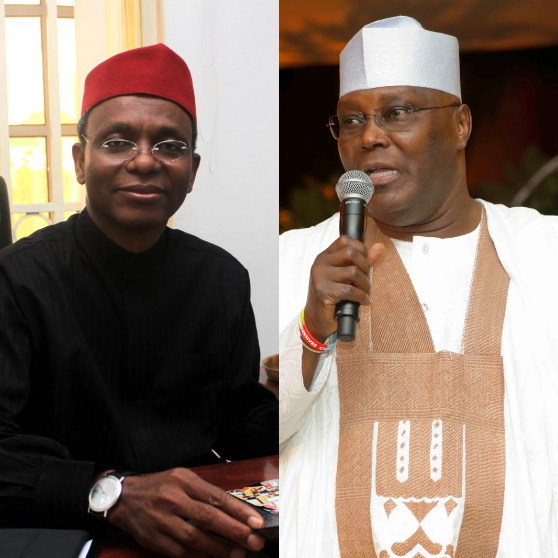
Atiku slams court over El-Rufai bail setback, warning harsh conditions may undermine justice and constitutional rights in Nigeria’s legal system
Former Vice President Atiku Abubakar on Tuesday, 24 June 2026, in Abuja, Nigeria, criticised a Federal High Court decision refusing to ease the bail conditions of former Kaduna State Governor Nasir El-Rufai, describing the ruling as a troubling development that raises concerns about fairness, constitutional liberty and due process.
Also read: Senator-elect Asogwa Predicts Strong 2027 Wins for Tinubu, Mbah in Enugu
Atiku Abubakar made the remarks through a statement issued by his Senior Special Assistant on Public Communication, Phrank Shaibu, following renewed public debate over El-Rufai’s continued detention by the Department of State Services after his arraignment.
The former Vice President argued that the essence of bail in law is to uphold the presumption of innocence, not to impose conditions that effectively prolong detention before trial.
He warned that excessively stringent requirements risk turning bail into what he described as a form of “constructive denial of liberty.”

According to Atiku Abubakar, the court-imposed conditions reportedly require El-Rufai to produce a serving Grade Level 17 federal civil servant who must also own verifiable property in high-value districts of Abuja, a requirement he said appears unusually restrictive and difficult to meet in practice.
In a strongly worded reaction, Atiku Abubakar said, “The law is settled that an accused person remains innocent until proven guilty. Bail exists to preserve that constitutional protection. It was never designed to become a sophisticated instrument for punishment before conviction.”
He further questioned whether the intention of such conditions was to grant bail or to make release practically unattainable, warning that such legal thresholds could undermine public confidence in the justice system if left unchecked.
Atiku Abubakar added that while courts retain the discretion to impose bail conditions, such discretion must remain reasonable, proportionate and consistent with constitutional safeguards.
He stressed that justice must not only be done but must also be seen to be done in a democratic society.
The former Vice President also broadened his concern beyond the current case, suggesting that there is a growing perception among citizens that legal processes are increasingly being used in politically sensitive matters involving opposition figures and critics of government.
He warned that democracy could be weakened if citizens begin to believe that the justice system is being applied unevenly or used as a tool of pressure.
In his words, “No democracy can thrive where citizens begin to suspect that legal processes are being used not merely to prosecute offences but to punish dissent.”
Atiku Abubakar clarified that his comments were not directed at determining El-Rufai’s guilt or innocence, emphasising that such matters remain strictly within the jurisdiction of the courts.
He maintained that his intervention was focused solely on protecting constitutional rights and ensuring fair legal standards.
El-Rufai, who served as Kaduna State Governor between 2015 and 2023, has remained in custody following his arraignment by the Department of State Services, with his bail conditions now becoming a subject of national debate and political commentary.
Legal observers note that bail conditions in high-profile cases often attract scrutiny, particularly when they involve stringent requirements tied to sureties, property ownership, or senior civil service guarantees.
Also read: Senator-elect Asogwa Predicts Strong 2027 Wins for Tinubu, Mbah in Enugu
The case continues to generate public attention as stakeholders call for a balance between safeguarding judicial processes and protecting individual rights under Nigeria’s constitutional framework.


