


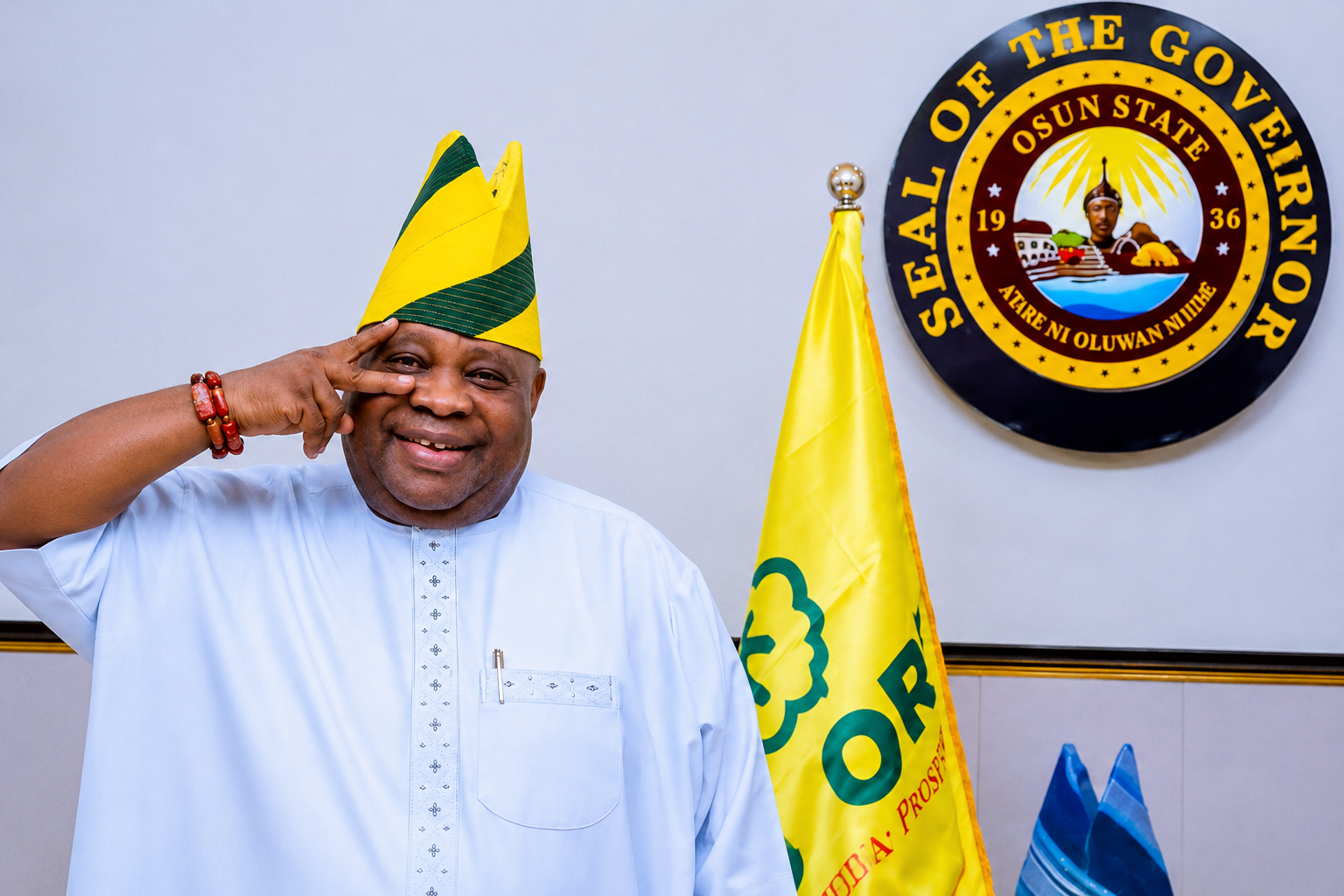
Adeleke wins Osun election with 511,067 votes as APC weighs legal action and President Tinubu calls for unity after a tense campaign
Governor Ademola Adeleke, Accord Party candidate; Bola Oyebamiji, All Progressives Congress candidate; President Bola Ahmed Tinubu; and the Independent National Electoral Commission have emerged at the centre of a consequential Osun State governorship contest after INEC declared Adeleke the winner in Osogbo on Sunday, August 16, securing his second term with 511,067 votes against Oyebamiji’s 444,815.
Also read: Ademola Adeleke: The power of dance as authentic branding proposition
The 66,252-vote margin gave Adeleke a clear victory in an election that had carried unusually high political stakes for Osun and attracted intense attention ahead of Nigeria’s 2027 general elections.
Adeleke won 19 of the state’s 30 local government areas, while Oyebamiji carried 11. African Democratic Congress candidate Najeem Salaam finished third with 17,180 votes. INEC’s declaration followed the collation of results from across the state’s 332 wards.
The result marks a notable turnaround from Adeleke’s first governorship race against the APC. In 2022, he defeated then-incumbent Gboyega Oyetola of the APC with 403,371 votes to Oyetola’s 375,027, winning 17 local government areas.

This time, however, Adeleke was not contesting under the PDP platform that first carried him to Government House.
He left the party amid its prolonged internal crisis and joined the Accord Party in November 2025, saying the move was intended to provide a stable platform for his re-election campaign and continued governance.
The switch was initially a political gamble. Accord had relatively limited institutional strength in Osun, with no local government councils under its control and no seats in the state assembly when Adeleke joined.
The campaign therefore became, in significant measure, a test of whether Adeleke’s personal political network and record in office could compensate for a weaker traditional party structure.
By February 2026, the political landscape around Adeleke had shifted considerably.
The Speaker of the Osun State House of Assembly, Adewale Egbedun, and 24 assembly members joined Accord, while six PDP members of the House of Representatives from Osun also defected to the party and backed Adeleke’s second-term bid.
The campaign unfolded against a difficult security backdrop.
A pre-election assessment by the Centre for Democracy and Development’s KDI recorded 73 election-related violent incidents and 29 deaths in the build-up to the poll, with Osogbo identified as the worst-affected area.
Reports from election day also recorded incidents of intimidation, shooting and disruption at some locations.
The police later said 295 suspects were arrested in connection with various incidents during the election.
Of those arrested, 293 were released on bail after screening, while two remained in custody for further investigation and possible prosecution.
Yet the election also produced signs of resilience. The European Union Support for Democratic Governance in Nigeria Election Observation Hub described the process as generally peaceful, orderly and inclusive, while the Transition Monitoring Group praised INEC for what it called a relatively seamless election and for the real-time uploading of results in most locations.
Yiaga Africa offered another important layer to the assessment.
The election observer said the official results were consistent with its independent statistical estimates and accurately reflected the ballots counted at polling units.
At the same time, it raised concerns about reports of vote buying, voter inducement and shortcomings in the use of electoral technology.
Those concerns have given the post-election debate a second dimension.
The African Democratic Congress congratulated Adeleke but asked INEC to explain an alleged interruption lasting nearly four hours in the uploading of polling-unit results to the IReV portal.
The party did not present evidence that INEC deliberately halted the uploads, but argued that the circumstances deserved clarification.
The Transition Monitoring Group, meanwhile, reported a more favourable assessment of the technology used during the poll, saying results were mostly uploaded in real time and that major technical problems were absent in most locations.
The differing observations underline why the credibility of the digital results trail is likely to remain part of the post-election conversation.
For the APC, the immediate question is whether the result will end at INEC’s declaration or move into the courts.
The Osun chapter of the party said it was reviewing results from all 332 wards before deciding on its next step.
Its spokesperson, Kola Olabisi, indicated that the party was prepared to explore the legal avenues available under the Electoral Act after consulting its lawyers.
That position does not yet amount to a formal election petition.
It does, however, leave open the prospect of a tribunal challenge as the APC examines the figures and any evidence gathered by its agents.
The Electoral Act 2026 provides a formal judicial route for challenging an election or return through an election petition before the appropriate tribunal.
The legislation also sets out a tightly regulated timetable for election petitions and subsequent proceedings.
President Bola Ahmed Tinubu has taken a different tone from the APC’s state chapter.
After INEC declared the result, Tinubu congratulated Adeleke and urged him to use his second term to bring together residents across political divides.
“The outcome of the election reflects the will of the people,” Tinubu said, according to a statement issued by his Special Adviser on Information and Strategy, Bayo Onanuga.
Adeleke also sought to lower the temperature after weeks of political confrontation.
In his victory remarks, he called on his opponents and supporters to reject reprisals and restore peace in communities affected by the violence surrounding the election.
“In this race, there is no victor, no vanquished. I extend an olive branch to my co-contestants. I am the Governor of all Osun people,” Adeleke said.
He pledged to build on what he considers the successes of his first term while addressing areas where his administration had fallen short.
His renewed agenda places emphasis on accelerated development, industrialisation, investment and broader delivery of public services.
The governor’s conciliatory message carries particular weight in a state where political rivalry has periodically spilled beyond campaign rhetoric.
His call for traditional rulers and community leaders to support peace-building reflects the reality that the aftermath of an election can be as consequential for ordinary residents as the result itself.
Najeem Salaam, the ADC candidate who finished third, also accepted the outcome and congratulated Adeleke.
Salaam said the electorate’s decision should be respected and urged the governor to use his second term to address weaknesses in his administration while consolidating its achievements.
“Politics is not a do-or-die affair. The people have spoken; democracy has prevailed,” Salaam said.
One of the election’s more striking political moments came from Adeleke’s renewed endorsement of Tinubu for a second presidential term in 2027.
Despite contesting against the APC in Osun, Adeleke has maintained that he supports Tinubu’s re-election and has described the President as a son of Osun and a leader of the South-West.
That position gives the Osun result a more complicated political character than a straightforward opposition victory.
Adeleke has retained his state-level mandate while publicly backing the incumbent President, even as opposition groups interpret his success as evidence that cooperation and candidate strength could reshape the political contest ahead of 2027.
For now, the immediate priority is less about national political calculations than what Adeleke does with the mandate he has secured.
The governor has promised reconciliation after a bruising campaign, while the APC is weighing whether the ballot box has delivered the final word.
Also read: Ademola Adeleke: The power of dance as authentic branding proposition
INEC’s declaration has settled the immediate electoral count, but the coming weeks will determine whether Osun’s 2026 contest becomes a settled political transition or the beginning of another prolonged legal battle.


