


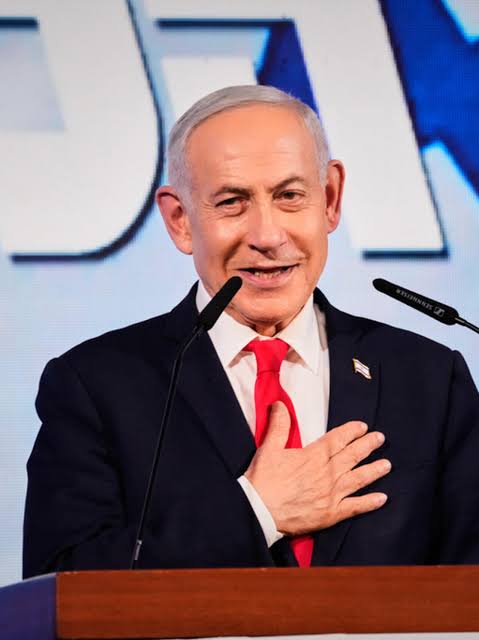
Netanyahu faces an election deadlock in Israel as his bloc falls short of a majority, leaving Arab-led parties and coalition talks central to the next government.
Israeli Prime Minister Benjamin Netanyahu is fighting to remain in power after Israel’s parliamentary election on Tuesday, 27 October 2026, produced no clear winner, leaving both Netanyahu’s right-wing bloc and opposition leader Gadi Eisenkot’s camp short of the majority needed to form a government in Jerusalem.
Also read:Akpabio Claims Tinubu’s Social Media Critics Are Paid
With preliminary results showing Netanyahu’s bloc ahead but unable to secure a governing majority, the outcome has opened a period of political uncertainty in Israel.
Arab-led parties have made significant gains and could prove decisive in determining whether Netanyahu remains prime minister or the opposition can assemble an alternative government.

The election, which attracted record-high turnout by recent standards, was widely regarded as a referendum on Netanyahu’s leadership following the Hamas-led attacks of 7 October 2023 and the wars that followed across Gaza and the wider region.
With more than 85 per cent of ballots counted in the initial tally, Netanyahu’s right-wing, far-right and ultra-Orthodox bloc was projected to win 53 seats in the 120-member Knesset, Israel’s parliament.
The broader opposition camp led by Eisenkot was projected to secure 48 seats, while Arab-led parties were on course to win 19.
A government requires the support of at least 61 lawmakers, leaving neither main camp with a clear route to power.
Although the remaining ballots could alter the final distribution, the preliminary figures have made coalition negotiations unavoidable.
Netanyahu and Eisenkot have both signalled their intention to seek the opportunity to form the next government.
Netanyahu’s position as leader of the largest party bloc may give him an initial advantage, but he will need to attract additional support or persuade political rivals to join a broader arrangement.
The opposition faces a different challenge. Although its combined parliamentary strength, including Arab-led parties, could potentially exceed the majority threshold, cooperation between the groups remains politically contentious.
Several opposition figures have previously rejected the prospect of forming a government with Arab parties, complicating Eisenkot’s efforts to build a viable coalition.
The election result has also placed President Isaac Herzog at the centre of the next stage of the process.
Under Israel’s parliamentary system, the president consults political parties before selecting a candidate considered best placed to form a government.
Herzog has urged political leaders to approach the negotiations with an open mind and avoid another election if possible.
The coming weeks are expected to test whether competing political interests can be reconciled into a functioning administration.
During the final hours of voting, Netanyahu made an urgent appeal to supporters to turn out for his Likud party, reflecting the stakes of a contest in which a small shift in support could affect the coalition arithmetic.
“We cannot leave this battle here in the hands of the left and the Arab parties,” he told a crowd in a Likud stronghold.
“So no barbecues, don’t go to the beach, go to the polling station and vote Likud.”
The appeal came as Netanyahu sought to defend a political career spanning decades.
His supporters point to his emphasis on national security and the military operations conducted against Hamas in Gaza, Hezbollah in Lebanon and Iran.
Critics, however, have questioned his handling of the security failures surrounding the October 2023 attacks and the prolonged regional conflicts that followed.
The attacks on 7 October 2023 profoundly damaged Netanyahu’s longstanding reputation as a leader capable of protecting Israel.
The subsequent war in Gaza, expanding confrontation with regional armed groups and direct conflict involving Iran have further shaped public debate about his leadership.
Netanyahu has sought to frame the military campaign as a generational struggle to reshape the Middle East and weaken Iran’s regional influence.
His supporters view the operations as evidence of determination in confronting security threats, while opponents argue that the prolonged fighting has imposed enormous human and diplomatic costs on Israel and deepened its international isolation.
The prime minister also faces legal and political challenges beyond the election. His longstanding corruption trial continues, while the International Criminal Court issued an arrest warrant for him in November 2024 over alleged crimes against humanity and war crimes in Gaza. Netanyahu rejects the allegations.
The election has meanwhile highlighted the growing political significance of Arab citizens of Israel. The projected 19 seats for Arab-led parties represent a substantial increase in their parliamentary influence, potentially giving them considerable leverage in negotiations even if they do not join a governing coalition.
Their position is complicated by Netanyahu’s repeated attacks on Arab political parties during the campaign.
Following the vote, he made unsubstantiated allegations of election theft and called for an investigation into claims of foreign funding.
Such accusations remain unproven, and the election outcome must be distinguished from claims about electoral misconduct.
For the opposition, working with Arab-led parties could provide a route to replacing Netanyahu, but it could also alienate right-leaning partners whose support would be needed to establish a stable government.
The competing demands leave Eisenkot with difficult choices as he seeks to translate opposition votes into parliamentary power.
A national unity government remains another possibility. Herzog has indicated that political leaders should consider arrangements capable of avoiding another election, while Netanyahu could seek to draw opponents into a broader administration, potentially under the argument that Israel requires a united front amid continuing security threats.
If no candidate can secure sufficient support through the prescribed parliamentary process, Israel could face another election.
Until a new government is formed, Netanyahu remains caretaker prime minister, allowing him to retain office while negotiations continue.
For now, the result offers neither Netanyahu a decisive mandate nor the opposition a straightforward path to power.
The final outcome will depend on the ability of rival parties to negotiate, the position adopted by Arab-led representatives and the willingness of political leaders to compromise.
Also read:Akpabio Claims Tinubu’s Social Media Critics Are Paid
The election has therefore left Israel at a critical political juncture, with the future of Netanyahu’s long tenure tied not only to the number of seats his bloc secures but also to the alliances he can build in the weeks ahead.


