


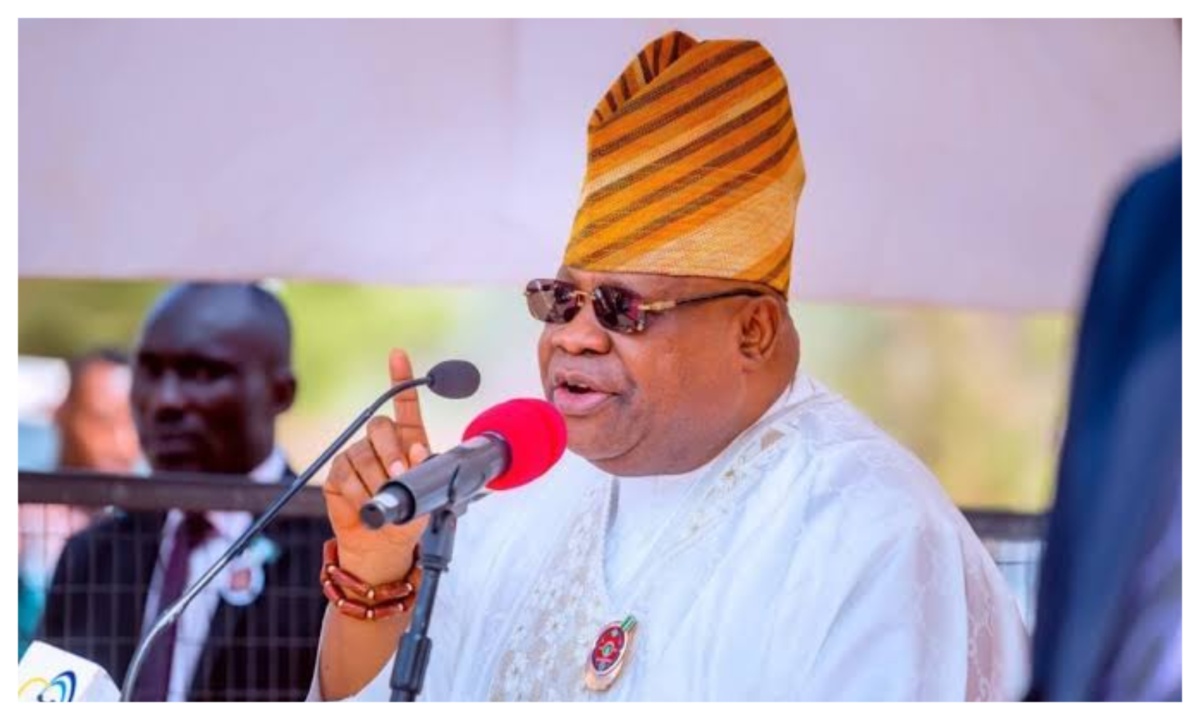
Adeleke APC defection rumours grow after his Tinubu visit, but the Osun governor says joining the ruling party is not on his agenda
Osun State Governor Ademola Jackson Nurudeen Adeleke and President Bola Ahmed Tinubu became the focus of renewed political speculation in Abuja after Adeleke visited the Presidential Villa following his victory in the August 15 governorship election, prompting the governor’s Imole Campaign Council to firmly reject rumours of an impending move from the Accord Party to the All Progressives Congress, APC.
Also read: Oyo 2027: ADC Guber Candidate Holds Secret Meeting With APM Chieftain Over Possible Alliance
The clarification came a day after Adeleke met Tinubu behind closed doors at the State House, his first publicly reported face-to-face meeting with the President since winning re-election.
Adeleke arrived at the Presidential Villa on Thursday accompanied by National Security Adviser Nuhu Ribadu and members of his political team.
The meeting was widely watched because Adeleke had only recently secured a second term on the Accord Party platform after leaving the Peoples Democratic Party, PDP.

The Imole Campaign Council subsequently described the visit as a customary political courtesy following an off-cycle election and rejected suggestions that the meeting was connected to negotiations over Adeleke joining the ruling party.
“The visit of Mr Governor and top members of his Campaign team had absolutely nothing to do with a plan to move from Accord to the All Progressives Congress,” the council said in its Friday statement.
The council added that “at no stage during the visit to Mr President was the issue of decamping to the APC discussed.”
The comments seek to draw a clear line between Adeleke’s growing working relationship with Tinubu and the political speculation surrounding his party affiliation.
The speculation is not entirely new. Adeleke’s political movements have repeatedly generated defection rumours, particularly since he left the PDP and secured the Accord Party ticket for the 2026 Osun election.
In June, Vanguard reported that some of Adeleke’s aides and Accord Party figures had already moved to the APC, adding another layer to questions about the governor’s political direction.
Adeleke’s relationship with Tinubu has also become more politically significant in recent months.
Ahead of the election, the Osun governor publicly endorsed Tinubu’s 2027 presidential bid and praised the President’s role in maintaining what he described as a credible electoral environment.
Following Adeleke’s victory, Tinubu congratulated the governor and urged him to use his second term to promote reconciliation and stability in Osun.
The President also cautioned against treating electoral victory as the defeat of political opponents.
Adeleke, for his part, has indicated that cooperation with the Federal Government does not necessarily amount to a party switch.
Speaking after his meeting with Tinubu, Adeleke said he was not currently considering returning to the APC.
“As I’m talking to you right now, I’m not even thinking about that. It’s not on my agenda,” the governor said.
He nevertheless expressed willingness to work with political actors supporting the President when their activities are directed towards Osun’s development.
“As long as they say, ‘I’m doing it for Mr President,’ I don’t mind. I will work with them,” Adeleke said.
The governor also explained that his support for Tinubu was influenced by the President’s position as a fellow Yoruba man and by the Federal Government’s development projects. He appealed to Tinubu to give greater attention to federal roads and other infrastructure in Osun State.
The distinction is important because Adeleke’s victory has altered the political balance in Osun.
The Accord candidate secured 511,067 votes in the August 15 election, defeating APC candidate Bola Oyebamiji, who recorded 444,815 votes, according to reports citing the declared results. The margin was 66,252 votes.
The result came after an intensely contested campaign marked by political tension and heightened security concerns.
In July, Inspector-General of Police Tunji Disu met Adeleke and other stakeholders in Osogbo amid concerns about political violence ahead of the poll.
The political history between Adeleke and the APC has also been complicated by earlier reports of possible realignment.
In June 2025, after Adeleke, members of his family and musician Davido visited Tinubu in Lagos, speculation similarly emerged that the governor could defect. Adeleke’s spokesperson dismissed those reports at the time, describing the visit as a routine courtesy call.
More recently, the governor’s camp has sought to distinguish his support for Tinubu from any political bargain.
Following speculation sparked by Aviation Minister Festus Keyamo’s remark that “Agreement is agreement”, the Imole Campaign Council said there was no political agreement behind Adeleke’s support for the President.
That history helps explain why Thursday’s meeting at the Presidential Villa quickly became the subject of renewed speculation.
For Adeleke, however, the immediate emphasis appears to be on governance rather than a change of party.
His request for federal support on infrastructure and his stated willingness to cooperate with actors working towards Osun’s interests point to a pragmatic relationship with the Federal Government.
The distinction may prove politically important as Adeleke begins his second term.
Cooperation with a president from another party can provide practical advantages for a state government, while remaining formally separate from a decision to join the ruling party.
For now, the governor’s position is unambiguous: despite his cordial relationship with Tinubu and his public support for the President’s 2027 bid, an APC defection is not presently on his agenda.
Also read: Oyo 2027: ADC Guber Candidate Holds Secret Meeting With APM Chieftain Over Possible Alliance
The latest clarification therefore appears less about ending speculation permanently than about establishing the political meaning of a high-profile presidential meeting: for Adeleke’s camp, the visit was an engagement between two elected leaders after a consequential election, not evidence of an imminent change of political home.


