


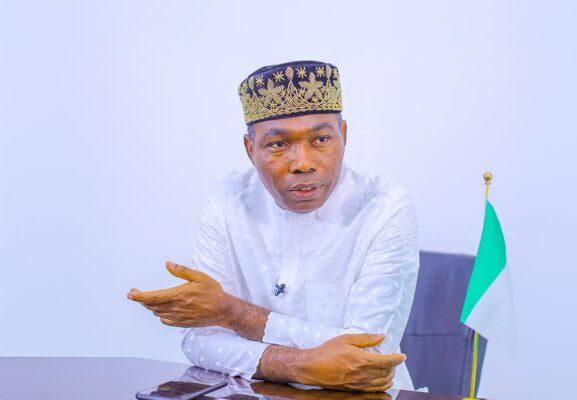
Adebayo Tinubu welfare clash deepens as the SDP politician accuses the government of neglecting Nigerians amid poverty, insecurity and unemployment
Prince Adewole Adebayo, a Social Democratic Party politician and 2027 presidential contender, has accused President Bola Ahmed Tinubu’s administration of placing Nigerians’ welfare too low on its priorities, citing poverty, insecurity, unemployment and inadequate electricity as evidence of what he described as weak people-centred governance.
Also read: ADC Warns of Fuel Hardship as Petrol Hits N1,470
Adebayo made the remarks in Abuja on Wednesday as political parties and their candidates intensify preparations for the 2027 presidential election.
The criticism forms part of Adebayo’s broader campaign message, which has focused heavily on poverty, insecurity and the need to reorganise government around measurable improvements in citizens’ lives.
“What is difficult to kill poverty and insecurity, blackouts, joblessness and all of that is that the welfare of the people is the last thing on the mind of the government,” Adebayo said, according to reports of his remarks.

He also called on Nigerian youths to organise ahead of the election, arguing that voters have the constitutional power to change governments through the ballot.
“We have fingers with which to thumbprint,” Adebayo said, referring to the voting process, while urging what he described as a new generation of Nigerians to take responsibility for the country’s political direction.
The remarks follow the recent unveiling of Adebayo’s 2027 to 2031 policy blueprint, Farewell to Poverty and Insecurity.
The document places human development, economic productivity, security and local infrastructure at the centre of his proposed approach to governance.
Adebayo has argued that Nigeria’s difficulties are not simply the result of a lack of resources but of how public resources and institutions are managed.
In an earlier presentation of the blueprint, he proposed making the Fundamental Objectives and Directive Principles of State Policy in Chapter Two of the 1999 Constitution a stronger basis for government programmes, budgets and performance reporting.
The candidate has also put fuel prices at the centre of his economic message.
In an interview reported earlier this month, Adebayo said an administration led by him would seek to bring petrol, cooking gas and aviation fuel prices down to N200 per litre within 12 months, while reviving existing refineries and encouraging modular refining.
The latest criticism therefore comes as part of a broader attempt to frame the 2027 contest around household welfare, economic management and security rather than personalities alone.
The political context is, however, more complicated than the campaign rhetoric suggests.
The Tinubu administration has defended its economic reforms, particularly the removal of the petrol subsidy and changes to foreign-exchange policy, as necessary measures intended to address longstanding fiscal and structural weaknesses.
The reforms have also generated significant debate over their immediate effects on household purchasing power.
Adebayo’s argument is that government policy should be judged primarily by its impact on ordinary Nigerians.
His recent blueprint promises a four-year programme covering security, energy, agriculture, education, healthcare, housing, infrastructure and social welfare.
His campaign council has argued that measurable improvements can be delivered within a single presidential term.
The political contest surrounding Adebayo also contains an unresolved party dispute.
Several recent reports continue to identify him as the SDP’s presidential candidate, including coverage of the party’s September convention and his campaign activities.
However, the SDP’s national leadership has separately issued a statement saying Adebayo was expelled from the party at its 20 May 2026 National Executive Committee and National Convention meetings and was never validly nominated as its presidential candidate.
The party has asked the Independent National Electoral Commission to review its published records.
That disagreement means Adebayo’s political status should be treated carefully until the relevant electoral and party records are conclusively resolved.
INEC’s current online election information lists the presidential and National Assembly election for 16 January 2027, although an earlier February 2026 commission statement had announced a different date.
For Adebayo, the central message remains focused on welfare and governance.
His recent public appearances have sought to turn poverty, insecurity, unemployment and energy costs into the defining issues of his political campaign.
For President Tinubu, the criticism adds to the wider debate over whether the administration’s economic reforms are translating quickly enough into improved living conditions.
As the 2027 political season develops, the competing arguments are likely to be tested not only through campaign speeches but also through economic indicators, security outcomes and the policy proposals presented to Nigerian voters.
Also read: ADC Warns of Fuel Hardship as Petrol Hits N1,470
The emerging Adebayo Tinubu welfare debate therefore reflects a broader question confronting the electorate: how should Nigeria’s next government measure economic progress, and how quickly should those gains be expected to reach households?


