


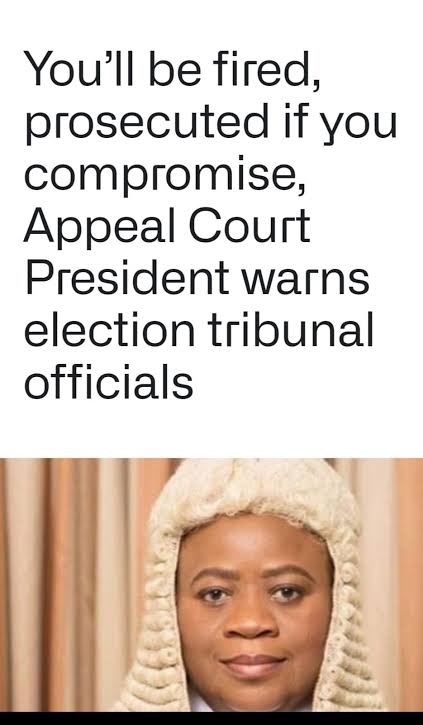
The Court of Appeal has warned 2027 election tribunal staff against bribery, intimidation and misconduct, threatening sanctions for corrupt officials
The President of the Court of Appeal, Justice Monica Dongban-Mensem, has warned secretaries and registry staff of election petition tribunals against accepting bribes or compromising judicial proceedings ahead of Nigeria’s 2027 general elections.
Also read: Bahrain Jails 64 Shia Muslims for Life Over Terror Links
Dongban-Mensem said officials found engaging in corrupt practices would face sanctions, stressing that their appointment was a call to national service rather than an opportunity for personal enrichment.
She gave the warning on Monday, November 16, 2026, in Abuja, while opening a two-day capacity-building workshop for tribunal staff themed, “Modern Registry Practices for Effective Election Petition Tribunal Administration”.
The Court of Appeal president said the workshop was designed to prepare officials for the administrative responsibilities involved in handling electoral disputes, describing the registry as the engine room of every tribunal.

She noted that the efficiency, integrity and transparency of registry operations were essential to the timely administration of electoral justice and public confidence in the judicial system.
According to her, tribunal registry staff are responsible for receiving and filing petitions, serving court processes, issuing hearing notices, preparing records of proceedings and orders, preserving documents and compiling case records.
She warned that poor administration or misconduct by registry officials could undermine the work of tribunals and damage confidence in the judiciary.
Dongban-Mensem also urged tribunal secretaries to familiarise themselves with the Electoral Act 2026 and the Election Petition Tribunal Proceedings Practice Direction 2026, warning that ignorance of the relevant provisions could expose them to intimidation, manipulation and costly administrative mistakes.
“As tribunal secretaries, as prescribed by the Electoral Act 2026 and the Election Petition Tribunal Proceedings Practice Direction 2026, you must know the Practice Directions and have them on your fingertips,” she said.
She added that officials who failed to understand the rules could be misled into making serious errors, with potentially significant consequences.
The Court of Appeal president further warned participants against allowing financial inducements to influence their decisions, saying their conduct and that of the tribunals would face intense public scrutiny.
“Let me be clear: you must discharge your duties with utmost good faith, and not be swayed by pecuniary inducements. Your conduct, and indeed, that of the tribunal, will be under intense public scrutiny,” she said.
She cautioned them against becoming instruments for frustrating judicial proceedings and urged them to protect the reputation of the judiciary.
“This assignment is not an opportunity for self-enrichment, but a call to national service, which is also an opportunity to build a good name. It is said that a good name is better than silver and gold. We will not hesitate to sanction any staff found wanting,” she added.
Dongban-Mensem also directed tribunal secretaries to ensure prompt service of court processes and maintain regular communication with the Election Petition Tribunal Unit at the Court of Appeal headquarters.
She explained that the presiding justice of each tribunal would serve as the immediate supervisor of its administrative staff and should be approached whenever they encountered difficulties.
The Court of Appeal president described the participants’ selection as evidence of the confidence reposed in them by the court, urging them to uphold the trust.
Also speaking, the Chief Registrar of the Court of Appeal, Umar Bangari, said the integrity of Nigeria’s democratic process depended on the efficient, transparent and timely resolution of electoral disputes.
He described the workshop as an administrative continuation of the training programme, aimed at equipping tribunal personnel with the technical knowledge required for their assignments.
Earlier, the Acting Deputy Chief Registrar of the Election Petition Tribunal, Maitumbi Altine, disclosed that 655 staff members and chief registrars were participating in the workshop.
She said 223 participants had previously served on election petition tribunals, while 432 would be taking up the assignment for the first time.
Altine also revealed that the Court of Appeal was working to update its Case Management System to prevent conflicting judgments, an administrative challenge tribunals had experienced in the past.
According to her, the court would upload judgments delivered by election petition tribunals since 1999 to provide judicial precedents on legal issues that could arise during the 2027 proceedings.
She also cautioned participants against granting media interviews without express authorisation, warning them to avoid activities that could undermine the neutrality of the tribunals or the Court of Appeal.
The presidential and National Assembly elections are scheduled for January 16, 2027, while governorship and state Houses of Assembly elections are expected to hold on February 6, 2027.
Also read: Bahrain Jails 64 Shia Muslims for Life Over Terror Links
The preparations follow the inauguration of 375 judicial officers by the Chief Justice of Nigeria, Justice Kudirat Kekere-Ekun, to serve on election petition tribunals across the country.


