


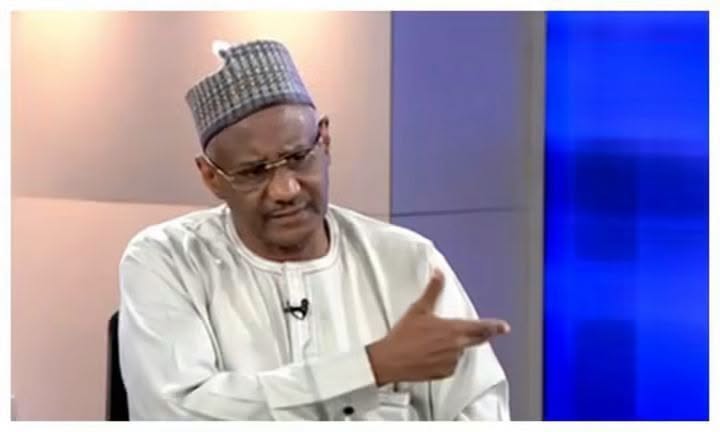
Northern voters are urged by Professor Usman Yusuf to reject vote buying and religious appeals, citing Osun’s 2026 election as a lesson
Professor Usman Yusuf, former Executive Secretary of the National Health Insurance Scheme, on Wednesday, August 26, 2026, urged northern voters in Nigeria to protect the value of their ballots by rejecting small cash inducements and religious appeals, citing the outcome of the August 15 Osun State governorship election as an example of the power of voters to determine political leadership.
Also read: Ndume Urges Tinubu to Quit 2027 Campaign Chair
Yusuf made the call during an interview with DCL in which he criticised what he described as vote buying, excessive security deployment and the use of religion as a political mobilisation tool.
His comments came 11 days after the Independent National Electoral Commission declared Ademola Adeleke of the Accord Party winner of the Osun governorship election.
Adeleke secured 511,067 votes across the state, defeating All Progressives Congress candidate Bola Oyebamiji, who polled 444,815 votes.

African Democratic Congress candidate Najeem Salaam finished third with 17,180 votes. Adeleke won 19 of Osun’s 30 local government areas, while Oyebamiji won 11.
Yusuf presented the Osun result as evidence that voters could still assert themselves despite the pressures surrounding an election.
He was particularly critical of the security arrangements for the poll, although his figure differs from the official deployment figures reported before the election.
“They sent over 30,000 security agents to Osun State to intimidate people. 30,000. If you sent 30,000 to Zamfara, all the insecurity in Zamfara will be gone,” Yusuf said.
Available pre-election figures show that 25,310 security personnel from the Nigeria Police Force, Nigeria Security and Civil Defence Corps and Economic and Financial Crimes Commission were deployed across Osun.
The police accounted for 15,000 personnel, while the NSCDC deployed 10,210 and the EFCC about 100.
The NSCDC separately ordered 10,000 personnel from neighbouring state commands to reinforce operations in Osun, while the police deployed senior officers, including a Deputy Inspector-General, to coordinate its election security arrangements.
The distinction is important because Yusuf’s broader argument rests on the scale of resources devoted to electoral security compared with the security challenges confronting parts of northern Nigeria.
“But no, the people, the lives of our people, are not as important as you rigging the ballot election,” he said.
Despite the heavy security presence, the election proceeded to a result that President Bola Ahmed Tinubu described as reflecting the will of Osun voters.
The President, himself an APC member, congratulated Adeleke and urged him to unite residents regardless of their political choices.
Yusuf’s central appeal was directed towards northern voters, whom he urged to consider the longer consequences of accepting money or other inducements during elections.
“And our voters in the north, the lesson you need to learn from Osun is whereas in Osun they gave them N30,000, N40,000, N50,000, here in the north they give you N500 and noodles to grab your lives for the next four years,” he said.
The allegation of vote buying is not unique to Osun, and Yusuf’s comments should be understood as his assessment rather than an independently established account of payments made to voters.
Election observers and Nigerian authorities have repeatedly identified vote buying as a challenge to electoral integrity, while the legal framework prohibits inducement of voters.
For Yusuf, the larger issue is the relationship between an immediate benefit and the quality of government that follows.
“We have a lot to learn in the north to tell you that we have the power. We vote this government in. We have the power to choose whoever we want to choose,” he said.
The argument is consistent with Yusuf’s previous public interventions on political accountability in northern Nigeria.
In January 2025, the former health insurance chief said northern voters had contributed to the region’s political difficulties and warned against relying on religious identity when choosing leaders.
He argued that insecurity, poor infrastructure and the education crisis should carry greater weight in electoral decisions.
His latest comments again placed religion at the centre of his criticism.
Yusuf challenged renewed appeals for support based on a Muslim-Muslim presidential ticket, describing the argument as a political device rather than a measure of good governance.
“And now they are bringing in these religious leaders back to you again to tell you to vote Muslim-Muslim, which I said from the outset was nothing but a scam. Nothing to do with Islam,” he said.
The comments reflect a position Yusuf has expressed previously.
In 2025, he argued that religious identity had deepened divisions in the North and maintained that political leaders had exploited religion at the expense of pressing social problems.
Yusuf’s criticism extends beyond elections to the conditions confronting communities across northern Nigeria.
He cited poverty, insecurity, hunger, drug abuse and the number of children outside school as issues that should command greater political attention.
“Our poverty has been deepened. Many more children are out of school, over 20,000 are out of school. Insecurity is worse, drugs all over,” he said.
The figure of “over 20,000” should be treated cautiously because Yusuf did not identify a source or specify whether he was referring to a particular state, category of children or the wider North.
National estimates of out-of-school children are considerably higher, making the context of his figure important.
He also questioned the extent to which military hardware alone could resolve insecurity, arguing that social and economic conditions must be addressed alongside security operations.
“You cannot solve this social problem,” Yusuf said, after arguing that even vast spending on military equipment would not by itself eliminate the roots of insecurity.
His remarks place the debate over voting behaviour within a wider question about governance.
A ballot is not merely an instrument for choosing a candidate, in Yusuf’s framing, but a means of rewarding or rejecting the policies and priorities of those seeking public office.
The Osun election provides a useful backdrop for that argument because the contest produced a relatively clear statewide verdict despite a closely fought campaign.
More than one million voters were accredited, with 1,005,800 votes cast and 985,079 recorded as valid.
The result also demonstrated that political loyalties were not uniform.
Adeleke won 19 local government areas, while Oyebamiji carried 11, showing that the election remained competitive across different parts of the state.
Yusuf’s message to northern voters is ultimately a call for political calculation rather than political passivity: assess what leaders deliver, resist pressure built around identity, and treat the vote as a powerful instrument of accountability.
He also called on religious leaders to focus more closely on social problems and hold political leaders accountable instead of becoming campaign advocates.
“This is not my Islam, they are not representing me, they are not representing hundreds of millions of Muslims in Nigeria. That’s all I have to say. Islam is better than they are,” Yusuf said.
His intervention adds another sharp voice to the growing debate over how religion, poverty, insecurity and electoral inducements could shape Nigeria’s political landscape ahead of the 2027 general elections.
Also read: Ndume Urges Tinubu to Quit 2027 Campaign Chair
For northern voters, the more enduring question may be whether the lessons Yusuf draws from Osun translate into a willingness to demand measurable results rather than short-term rewards when the next ballot arrives.


